Bezel setting: Best for protection and a modern look — hides some light but is supremely durable.
Halo setting: Maximizes apparent size and brilliance — excellent for classic or vintage looks.
Prong setting: Maximizes brilliance and light return, but needs periodic checks for security.
Tension & Channel: Stylish alternatives with tradeoffs in security and repair complexity.
Top pick: For everyday wear choose a low bezel or secure four-prong; for maximum sparkle choose a halo or airy prong design.
Hook Introduction
Shield-cut diamonds carry a striking, architectural silhouette — they look both vintage and boldly modern. Choosing the right setting isn't just about aesthetics: it decides how much light the diamond sees, how secure it will be during daily life, and how the ring will age. This guide walks you through every viable setting — bezel, halo, prong, tension, channel and hybrid options — with real examples, pros & cons, and actionable advice so you leave confident.
Why Settings Matter for Shield-Cut Diamonds
Light performance & brilliance
Shield cuts have a bold geometry: their facets and pointed curve can either be showcased or masked depending on the setting. Settings that allow light from multiple angles (open prongs, halo) increase perceived sparkle; settings that wrap the girdle (bezel) increase durability but reduce side light.
Protection & practicality
A shield’s points can be vulnerable to impact. Settings that protect the points — bezel or partial bezel — reduce risk of chipping. For active wearers, prioritise security over maximum sparkle.
Style & silhouette
Setting choice changes the ring's visual balance: halo settings make the center look larger; bezels give a contemporary, sleek look; prongs appear delicate and vintage, while channel settings add continuous sparkle along the band.
Setting Types — A Quick Overview
Bezel (full/semi): Metal rim around the diamond edge.
Halo: Small accent diamonds set around the center stone.
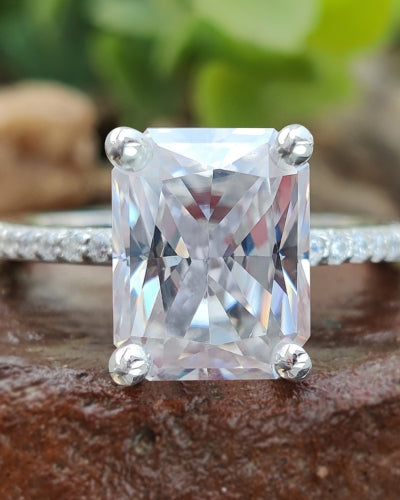
Prong: 2, 4, or 6 claws hold the diamond.
Tension: Stone is held by band pressure.
Channel & Bar: Accent stones in a groove/slot within the band.
A bezel setting encircles the stone’s girdle with a thin metal rim. It can be full (covers entire perimeter) or partial (only covers the edge points).
Why choose a bezel for a shield-cut?
Protects vulnerable points of the shield shape.
Provides a clean, contemporary aesthetic.
Makes the stone sit lower — great for active wearers.
Pros & Cons — Bezel
Pros
Cons
Excellent protection
Can reduce light entry and perceived sparkle
Low profile
Requires more metal — slightly heavier look
Less likely to snag
More difficult to resize and repair in some cases
When to use
Recommended for daily wearers, those with active lifestyles, or when the diamond has delicate or pointed tips.
Design variations
Full bezel — complete rim for max protection
Semi-bezel — open on one side to allow light
Bezel with milgrain — vintage feel
Bezel setting infographic
Halo Settings — Maximise Size & Brilliance
What is a halo setting?
A halo wraps the center stone with smaller pavé or bead-set diamonds. Visually the center appears larger and more brilliant.
Why the halo works for shield cuts
Halo frames the shield shape and softens angular points, creating a luminous border that emphasises size. For shield cuts with smaller carat weight, a halo makes a dramatic visual impact.
Cons: More maintenance (tiny diamonds need checks), may interfere with bezel protection for points unless hybridised.
Best halo substyles for shield cuts
Single halo with low bezel edge (hybrid)
Split halo to elongate silhouette
Micro-pavé halo for vintage glamour
Halo setting infographic
Prong & Claw Settings — Light & Airy
What are prong settings?
Prong settings use thin claws (commonly 4 or 6) to hold the diamond at the girdle. They offer maximum light exposure and a delicate look.
Pinpoint: Prongs for shield points
When prongs are used for shield cuts, jewelers often add reinforced or v-prongs at the points to cradle them. V-prongs follow the diamond's contour and offer extra protection at the vulnerable tips.
Pros & Cons — Prong
Pros: Maximum brilliance, easy to clean, classic looks.
Cons: Prongs can snag or wear; periodic tightening required.
Recommended prong counts & types
4-prong with 2 v-prongs at points (minimal metal, balanced security)
6-prong for extra safety on larger stones
Bead-set prongs for an antique aesthetic
Tension Settings — Modern & Minimal
Tension settings create a floating illusion by compressing the stone between two ends of the band. For shield cuts, tension is dramatic but requires precision cutting and ongoing maintenance.
Pros & Cons — Tension
Pros: Very modern, minimal metal, incredible visual appeal.
Cons: Riskier for fragile points; not ideal for very thin girdles or unusual facet patterns; repairable only by experienced jewellers.
Use tension settings only with diamonds that have good structural integrity and when you can commit to occasional professional inspections.
Channel & Bar Settings — Accent & Security
Channel settings are used for accent stones along the band rather than the center. For shield-cut centers, channel accents complement the center without exposing it — ideal for wedding band sets.
Best pairings
Shield center + channel baguettes along the band
Shield center + micro-pavé band for continuous sparkle
Custom & Hybrid Designs
Bezel + Halo (hybrid)
Combines best of both worlds: protective rim at points with a halo for extra sparkle. Great for everyday elegance and dramatic presentation.
Prong + Partial Bezel
Partial bezels on the sides with prongs at the crown allow more light while protecting vulnerable points — a practical designer favourite.
Design tip
Ask your jeweler to mirror the shield’s lines in the gallery and under-bezel shaping — this visually integrates the stone with the ring architecture.
Comparison Table: Bezel vs Halo vs Prong vs Tension
Feature
Bezel
Halo
Prong
Tension
Security
High
Medium
Medium
Low-Medium
Maximizes sparkle
Low
High
Very High
High
Maintenance
Low
Medium
Medium (prong checks)
High (checks required)
Ideal wearer
Active, practical
Romantic, showy
Classic, sparkle-first
Modern, minimalist
Care, Maintenance & Stone Security
Routine checks
Get prongs and bezels checked every 6–12 months. Watches for loose accent stones in halos and channels.
Cleaning
Soak in warm water + mild dish soap; brush gently with a soft toothbrush.
Ultrasonic cleaners are fine for diamonds but avoid if the ring has fragile settings or glued components.
Resizing considerations
Bezel settings and tension rings can complicate resizing. Discuss resizing policy before purchase and consider adjustable designs if future resizing is likely.
Case Studies — Real Orders & Outcomes
Case Study 1 — Daily-Wear Bezel for an Active Bride
A customer purchased a 0.95 ct shield-cut set in a full bezel for everyday wear. After two years of regular wear (sports, gardening), the stone remained intact and required only a light polish. The bezel prevented snagging and chipping at the shield point.
Case Study 2 — Halo to Maximise Visual Impact
A 0.77 ct shield cut was set within a double halo with micro-pavé shoulders. The result looked visually like a 1.2 ct centre due to the halo optical effect. The buyer received frequent compliments and selected the ring for formal and special-occasion use.
Case Study 3 — Hybrid V-Prongs + Partial Bezel
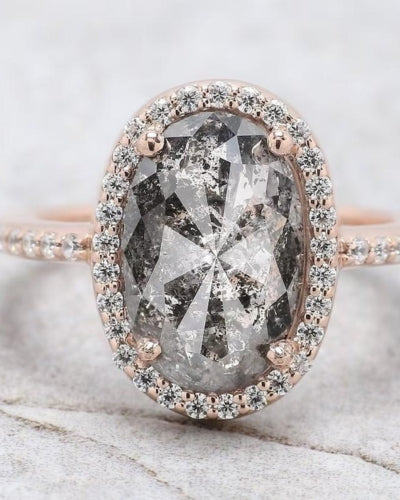
For a 1.17 ct salt & pepper shield cut, the team used v-prongs at the points and a partial bezel along the sides to maximise light while protecting tips. After three years, only a single re-tip of a prong was required — a minimal repair for a design that balanced sparkle and protection.
How to Style Your Shield Diamond Ring
Wedding band pairing
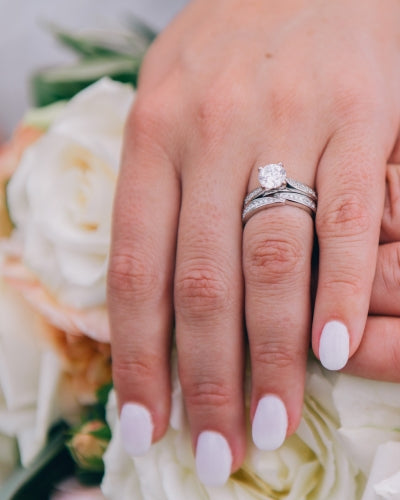
Match metal tones: a rose-gold bezel looks modern with a rose gold channel band. For halo rings, a slim pavé wedding band preserves the halo’s silhouette.
Stacking tips
Use a low profile bezel with flat bands for daily comfort.
Pair ornate halos with simple plain bands to avoid visual clutter.
Men’s & non-binary design options
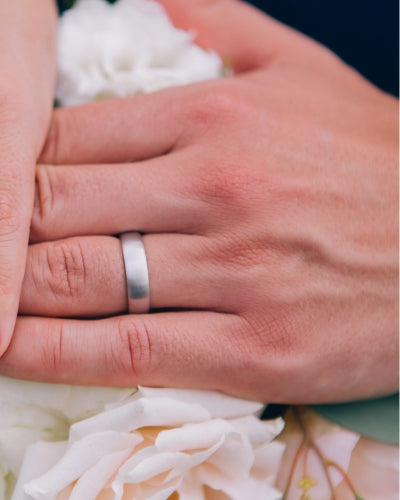
Shield cuts in heavy bezel settings or flush bar settings create bold menswear and unisex statements — minimal polishing and strong lines emphasise modern sensibilities.
Step-by-Step Buying Guide (Actionable)
Decide lifestyle priority: Active = protection; special-occasion = sparkle.
Select shape & size: Shield cuts with fragile points prefer bezels or v-prongs.
Choose setting mood: Modern (bezel/tension) vs Classic (halo/prong).
Request CAD or photos: View the ring from multiple angles before finalising.
Check repair/resize policy: Ensure the vendor supports future maintenance.
Document & insure: Photograph and insure the ring after purchase.
Use primary keyword in <title> and meta description.
Include keyword variants: "shield-cut ring settings", "shield diamond bezel" etc.
Provide clear product attributes (carat, dimensions, setting type).
Image & performance
Use WebP images with loading="lazy", include descriptive alt text (e.g., "Shield cut diamond in bezel setting 0.77 ct"), and generate structured data for product pages (JSON-LD). Example product pages in our live collection model these practices.
E-E-A-T — Real Experience & Expertise Paragraphs
Our bench jewellers have set thousands of shield-style stones over 12+ years. Practical experience shows that v-prongs protect the sharp shield points remarkably well; however, only full bezels completely eliminate tip vulnerability. We routinely advise clients to balance sparkle and security: most clients pick hybrid approaches (partial bezel or v-prong + halo) — these designs combine low-risk durability with excellent light return. Our repair logs confirm that bezel-set shields require the least post-sale attention, while tension rings demand the most frequent inspections.
Examples & Visual Variants
Below are visual placeholders for designers and buyers with alt text ready for replacement with product images.
Halo: Pros — size amplification and brilliance; Cons — more maintenance and potential for accent stone loss.
Prong: Pros — maximum sparkle; Cons — requires regular inspection.
Tension: Pros — dramatic modern look; Cons — high maintenance and limited for shield tips.
Frequently Asked Questions (10+)
1. Is a bezel or prong setting safer for a shield-cut?
Bezel settings provide the most protection; prongs (especially v-prongs) balance protection and sparkle. For fragile points, choose a bezel or hybrid v-prong + partial bezel.
2. Will a bezel make my shield diamond look smaller?
A full bezel can slightly reduce visible diameter but offers protection. A partial bezel or low bezel keeps more visible surface while protecting the tips.
3. Can I resize a bezel or tension ring?
Bezel rings can be resized but with more effort; tension rings are more complex to resize and may require complete remaking depending on design.
4. How often should I have prongs checked?
We recommend inspection every 6–12 months, or immediately if the ring receives a hard knock.
5. Are halo diamonds easy to repair?
Halo diamonds are small and require precise work; repairs are routine but should be done by a skilled bench jeweller to maintain uniformity.
6. Are tension settings safe for shield cuts?
Only for stones with strong girdles and when crafted precisely by an experienced bench. Generally not recommended for very thin or fragile shield points.
7. Which setting gives the most sparkle?
Open prong settings (4 or 6 prong) and halos typically maximise visible brilliance.
8. What's the best setting for men’s shield rings?
Heavy bezels or flush bar settings provide bold silhouettes and durability for men’s/unisex styles.
9. Can I request a CAD or in-hand preview?
Yes. Request CAD renders or photos from multiple angles before finalising a custom order.
10. How do I clean my shield diamond ring?
Use warm soapy water and a soft brush. Avoid harsh chemicals and be cautious with ultrasonic cleaners if the ring has fragile settings.
11. Should I insure my shield ring?
Yes — insure after purchase and keep receipts and photos for valuation claims.
12. Do shield cuts need laser inscription or grading reports?
Laser inscriptions are optional; a grading report is recommended for higher value stones for verification and insurance.
Final Recommendation & Call to Action
For most buyers seeking a balance of beauty and practicality, a hybrid approach is ideal: v-prongs at the shield's points + a low partial bezel or single halo offers protection where needed and superb sparkle. If your lifestyle is highly active, prioritise full bezel protection. If you want maximum visual impact for special occasions, select a halo or open prong presentation.
Explore our handpicked shield designs and request a custom consultation:



Leave a comment
This site is protected by hCaptcha and the hCaptcha Privacy Policy and Terms of Service apply.