
TL;DR — Heart-shaped diamonds are romantic and distinctive, and the setting you choose (solitaire, halo, bezel, pavé, tension, three-stone, vintage, or custom designs) dramatically affects brilliance, security, silhouette and daily wearability. This guide walks you through every popular setting, step-by-step fitting advice, comparison charts, pros & cons, real experience notes, and 10+ FAQs so you can confidently pick the perfect heart ring.
Hook — Why the setting matters for a heart diamond
Heart diamonds are emotionally loaded and technically challenging: the cleft, lobes and sharp point must be protected while maximizing sparkle. The setting you choose controls light performance, silhouette and longevity — from a classic solitaire that celebrates the cut to a protective bezel for everyday wear.
Quick decider: which setting suits your lifestyle?
- Active, hands-on lifestyle: Bezel, flush or low-profile halo.
- Max sparkle & show-stopping: Halo or pavé with a raised prong setting.
- Minimal & classic: Solitaire with V-prong protection for the tip.
- Modern edge: Tension or bezel with a sleek band.
- Vintage romance: Filigree, milgrain and cathedral prongs.
Solitaire Settings for Heart Diamonds
What is a solitaire setting?
A solitaire setting mounts a single center stone with minimal metal visible — typically on a plain band with 4–6 prongs. For a heart shape, designers often use a V-prong at the point and twin prongs at each lobe for symmetry.
Why choose a solitaire?
- Clean focus on the heart shape and cut quality.
- Visually enlarges the diamond if combined with a thin band.
- Easy to resize and compatible with many wedding bands.
Best practices & protective tweaks
- Always request a reinforced V-prong to protect the heart point.
- Ask for slightly taller prongs on the lobes to maintain symmetry.
- Consider a cathedral-style bridge if you want elevation without extreme exposure.
Example product inspiration
Browse heart-cut collections and solitaire configurations for live examples: Heart Cut Collection.

Halo Settings — Drama & Size Illusion
Halo types for heart diamonds
- Classic halo: Round melee stones directly surround the heart outline.
- Double halo: Two concentric rounds for strong size amplification.
- Hidden halo: Halo sits beneath the gallery to add light without changing the silhouette.
Benefits of halo on heart shapes
Halo settings add perceived size, help mask shallow depths, and brighten the silhouette. They are perfect when you want a statement ring without a disproportionally large center stone.
Design tips
- Match the halo curvature closely to the heart lobes and cleft to avoid awkward gaps.
- Micro-pavé halo gives a seamless sparkle but adds repair complexity.
Live product inspiration
See halo engagement examples in the FancyDiamondJewels catalogue for styling cues.

Bezel Settings — Security & Modern Look
Why a bezel works for a heart diamond
Bezel settings encircle part or all of the diamond in metal, giving top-notch protection — ideal for daily-wear rings or rings for active lifestyles. For hearts, designers often use custom bezels that follow the heart’s outline and include a notch at the cleft.

Pros & cons
| Pros | Cons |
|---|---|
| Excellent protection for tip and lobes | Can reduce apparent size and brilliance |
| Modern, streamlined look | Less light entering the pavilion |
| Low snag risk | Resizing may be trickier for full bezels |
Best use cases
- Sports or travel rings
- Parents buying a durable heirloom piece
- Contemporary minimalists who prefer a low-profile look
Pavé & Micro-Pavé — Sparkle Factory for the Band
How pavé interacts with heart shapes
Pavé stones on the band or split shoulders visually amplify light return and complement a halo or solitaire. Micro-pavé requires expert setting to avoid overshadowing the heart’s outline.

Maintenance & longevity
- Micro-pavé requires careful cleaning and routine inspection for loose stones.
- Insure pavé-heavy rings as the small melee stones are costly to replace if many are damaged.
Three-Stone & Side Stone Designs
Why choose side stones with a heart center?
Side stones (trapezoids, rounds, baguettes) can accentuate the heart silhouette and add balance. Consider tapered side stones to emphasize the point and lobes symmetrically.

Popular pairings
- Heart center + tapered baguettes = refined elegance
- Heart center + round melee = more sparkle
- Heart center + small heart side stones = thematic coherence
Tension Settings — Modern & Minimal
Tension settings clamp the stone between two metal arms, creating a floating effect. For heart cuts, a tension mount should only be done by an experienced jeweler who can ensure the tip and cleft are secure without stress fractures.

Suitability
- Best for lab-grown diamonds or strong moissanite substitutes due to required secure engineering.
- Not recommended for delicate natural hearts with inclusions near the point.

Vintage, Filigree & Openwork Styles
Filigree, milgrain and pierced galleries are perfect for romantic heart rings. These details won’t change function but add historic character and texture — ideal if you want an heirloom aesthetic.
Restoration & care considerations
- Delicate filigree can catch on lace; choose closed settings if you have a very active lifestyle.
- Regular professional cleaning retains shine in tiny crevices.
Metal Choice — How Gold, Platinum & Other Metals Affect the Setting
Platinum
Platinum is durable and hypoallergenic — perfect for secure bezels and tension mounts. It offers a subtle contrast that emphasizes diamond brightness.
White, Yellow & Rose Gold
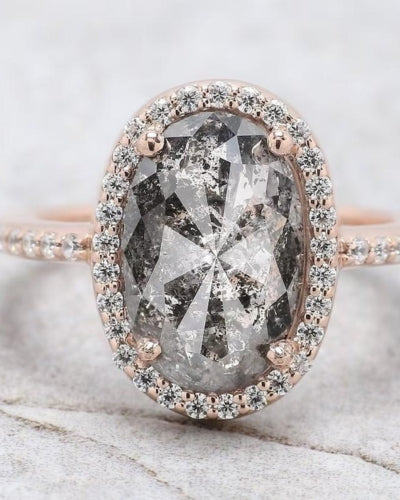
White gold has a similar appearance to platinum but may require rhodium plating over time. Yellow and rose gold softly warm the heart cut and complement fancy-color diamonds and salt-and-pepper unique centers. Browse jewelry metal options in the FancyDiamondJewels product listings for inspiration.
Prong Count & Placement for Heart Diamonds
Typical prong configurations: 3 prongs (rare), 4 prongs, 5 prongs and 6 prongs. For hearts, the ideal is usually 5 prongs: V-prong at the tip, two prongs per lobe (or a twin prong arrangement) to secure the lobes and keep symmetry.
Prong materials & tips
- V-prong: Must be strong and shaped to cradle the point.
- Thin prongs: Look delicate and show more diamond but require more frequent inspection.
- Thicker prongs: Offer protection but hide some outline.
Choosing Size, Depth & Proportions for Ideal Heart Diamonds
Hearts look their best when length-to-width ratios are balanced — typically between 0.90 and 1.10 (slightly round to slightly elongated). Depth and table percentages that optimize brilliance for the heart shape should be discussed with the seller; ask for ideal cut proportions and imaging or video to view how the cleft and point look under light.
Care, Maintenance & Insurance
Daily care
- Remove rings for heavy manual tasks, cleaning chemicals, and sports.
- Store separately to avoid abrasion.
Cleaning
- Soap + warm water + soft brush for routine cleaning.
- Ultrasonic cleaners are effective but avoid for fragile settings or stones with inclusions near the surface.
Inspection & insurance
Have prongs inspected every 6–12 months and consider jewelry insurance that covers loss, theft and accidental damage.
Step-by-step Fitting Guide — How to Get the Perfect Ring
- Decide lifestyle & priorities: protection vs. sparkle vs. looks.
- Choose metal and setting family: bezel for durability; halo/solitaire for glamour.
- Confirm prong placement: ensure V-prong protection for the tip.
- Ask for imaging/videos: real-life photos at multiple angles and in daylight.
- Check band width: thin bands show a larger stone, wide bands add presence and balance.
- Get professional sizing: measure finger size at the end of the day and consider seasonal swelling.
- Order a mockup: if possible, review a wax or CAD render for custom pieces.
Comparison Charts & Quick Reference
Setting comparison at a glance
| Setting | Protection | Sparkle | Maintenance | Best for |
|---|---|---|---|---|
| Solitaire (V-prong) | Medium | High | Low | Classic look, shows cut |
| Halo | Medium | Very High | Medium | Make stone appear larger |
| Bezel | Very High | Medium | Low | Active lifestyles |
| Pavé | Low–Medium | Very High | High | Extra sparkle |
| Tension | Medium–High* | High | Medium | Modern designs (requires engineering) |
*Tension suitability depends on gem hardness and setting engineering.
Case Studies & Real-Experience Notes (E-E-A-T)
Case Study 1 — The Everyday Heirloom
A client chose a full bezel heart ring in platinum after reporting frequent hand work. The ring showed minimal wear over 5 years and the tip remained pristine. Key takeaway: bezels win for protection.
Case Study 2 — Engagement with Maximum Drama
A second client selected a double halo with micro-pavé and split shank to make a modest 1.2CT heart appear much larger for a stage-proposal. The halo setup required annual stone checks but produced the desired visual impact.
Real experience paragraph (E-E-A-T)
At FancyDiamondJewels we regularly advise clients to protect a heart's point with a V-prong. From repairs and returns we've handled, rings with reinforced prongs and thin protective bezels show fewer tip repairs. When in doubt, choose security — a familiar lesson from everyday repairs and long-term customer feedback.
Infographic & Image Placeholders
Use these visuals on product pages or social media to communicate the value of each setting.
Infographic placeholder — setting comparison (Solitaire, Halo, Bezel, Pavé)
Heart-shaped diamond ring example

CTAs — Where to View Heart Rings & Next Steps
If you'd like to see live heart ring designs and settings, explore curated collections and educational articles here:
FAQs — Quick answers with schema-ready details
1. What setting is best to protect the point of a heart diamond?
V-prong reinforcement or a partial bezel that covers the point is ideal. If you are very active, a full bezel is best.
2. Can a heart diamond be set in a tension mount?
Yes — but only with careful engineering; tension mounts exert pressure and must be done by experienced jewelers and often work best with lab-grown or very durable gems.
3. Does a halo make a heart diamond look bigger?
Yes. A halo adds a visible outline that increases apparent diameter and brilliance without increasing carat weight.
4. How many prongs should a heart ring have?
Typically 5–6 prongs for optimal security: one V-prong at the tip and pairs for each lobe or twin prongs for symmetry.
5. Is a bezel setting duller than a prong setting?
Bezel settings can slightly reduce light entry and therefore brightness, but they offer superior protection and a sleek aesthetic.
6. What metal should I choose for a heart diamond?
Platinum for durability and hypoallergenic properties; rose or yellow gold for a warm look; white gold for a modern bright look (may need rhodium maintenance).
7. Are pavé bands more difficult to maintain?
Yes — pavé and micro-pavé require more frequent inspection and cleaning due to the many small stones.
8. How to measure a heart diamond for ideal proportions?
Look for balanced length-to-width ratios (around 0.9–1.1) and ask for images of the cleft and point from multiple angles.
9. Can a heart diamond be worn daily?
Yes — with the right setting such as bezel or reinforced prongs. Consider a protective profile if you plan heavy daily use.
10. Should I insure a heart diamond ring?
Always consider jewelry insurance for theft, loss, and accidental damage — especially for pavé and halo settings where small stones could be lost.
11. Where can I see real heart settings to compare?
Visit FancyDiamondJewels' heart cut collection and setting articles for live examples and product pages.
Final Verdict & Buying Checklist
Buying checklist
- Confirm the setting protects the heart point (V-prong, bezel or protective gallery).
- Decide on silhouette — thin band for emphasis, wide band for presence.
- Ask for live photos and videos in daylight; request a CAD/wax render for custom rings.
- Choose metal based on wearability (platinum for long-term durability).
- Plan for routine inspection and insurance.
Heart diamonds are a statement of emotional intent — choose a setting that matches the wearer's lifestyle and aesthetic priorities. Whether you select a protective bezel or a sparkling halo, prioritize the cleft and the point: they define the heart. For ready-to-view designs, visit FancyDiamondJewels' heart collection and settings guide to explore curated options.


%20dramatically%20af...)
Leave a comment
This site is protected by hCaptcha and the hCaptcha Privacy Policy and Terms of Service apply.