
Artikel: The History of Colored Diamonds: From Ancient India to Modern Luxury Jewelry
The History of Colored Diamonds: From Ancient India to Modern Luxury Jewelry
Imagine a gemstone formed deep within the Earth billions of years ago, carrying a natural shade that cannot be perfectly duplicated by any other stone. Its color may be a delicate blush pink, a warm champagne brown, a vivid yellow, a mysterious green, or a deep ocean blue. Long before colored diamonds became celebrated in contemporary engagement rings and fine jewelry, exceptional diamonds were treasured by rulers, collectors, merchants, and royal families.
The history of colored diamonds is a story of geology, ancient trade, craftsmanship, cultural symbolism, scientific discovery, and changing ideas of luxury. From India's historic diamond-producing regions to the royal treasuries of Europe and the personalized jewelry designs of today, natural colored diamonds have continually captured human imagination. Colored Diamonds Modern Luxury Ring
Unlike traditional colorless diamonds, fancy color diamonds are valued for the distinctive hues that make each gemstone visually individual. Their color, intensity, rarity, cutting style, and documented identity all contribute to their appeal. Some are prized for their vivid saturation, while others attract attention through subtle brown, gray, olive, or champagne tones.
In this comprehensive guide, discover how colored diamonds evolved from ancient treasures into modern luxury jewelry, why certain colors became famous, how diamond cutting changed their appearance, and what today's jewelry buyers should understand before selecting a natural colored diamond.
Luxury collection of natural colored diamonds in pink, yellow, blue, green, champagne, and brown hues

1. What Are Colored Diamonds?
Colored diamonds are diamonds whose visible body color extends beyond the near-colorless range. In gemology and jewelry commerce, the term fancy color diamond generally refers to a diamond displaying a noticeable natural hue that is evaluated using a specialized color-grading approach.
These gemstones can appear in yellow, brown, pink, blue, green, orange, purple, gray, red, and combinations of colors. Some have a pure, clearly defined hue, while others display secondary colors that create a distinctive overall appearance. A grayish-blue diamond, for example, looks different from a vivid blue diamond even though both belong to the blue color family.
Why are colored diamonds different from colorless diamonds?
For many near-colorless diamonds, less visible body color is traditionally preferred. Fancy color diamonds follow a different value pattern: stronger and more attractive color can increase desirability, although the final value also depends on rarity, clarity, size, cut, and market demand.
Colored diamonds are not all intensely saturated. A soft champagne stone, a pale yellow diamond, and a gray diamond with natural inclusions can all appeal to different buyers. The best choice depends on personal taste, the intended jewelry design, and the importance of color intensity to the purchaser.
Natural color versus the appearance of color
A diamond's appearance may be influenced by lighting, surrounding metal, the angle of observation, photography, and the way the stone has been cut. A yellow-gold setting may make a warm-colored diamond appear more harmonious, while white metal can emphasize contrast. Photographs alone cannot reliably establish whether a diamond's color is natural, treated, or accurately represented.
2. The Origins of Diamonds in Ancient India
India holds a central place in the early history of diamonds. For many centuries, historic Indian deposits supplied diamonds to regional rulers, merchants, and international trading networks. These stones traveled through commercial routes connecting South Asia with other parts of Asia, the Middle East, and Europe.
Diamonds recovered from ancient Indian deposits were often found in river gravels and other alluvial materials. Unlike modern large-scale mining operations, early recovery methods relied heavily on locating diamond-bearing sediments and separating gemstones from surrounding material.
Historic diamond sources in the Indian subcontinent included areas associated with the Golconda region, as well as other deposits in central and southern India. The name Golconda later became closely associated with celebrated diamonds admired for their exceptional reputation and historical importance.
How early diamonds were used
Diamonds were valued for more than decoration. They could signify authority, wealth, spiritual importance, and social position. Their remarkable hardness distinguished them from many other gemstones, while their scarcity made them suitable for royal treasuries and elite adornment.
Early diamond jewelry did not always resemble modern engagement rings. Diamonds could be incorporated into elaborate ornaments, ceremonial pieces, pendants, and other forms of royal jewelry. The design of a historic gemstone was shaped by the metalworking skills, cutting techniques, cultural preferences, and practical limitations of its period.
The history of colored diamonds must be understood within this wider story. Historic diamonds were not always documented using today's standardized color descriptions. A gemstone described in an old inventory may have been identified by a broad visual impression rather than a modern laboratory grade.
3. Early Beliefs About Diamond Colors
Color has influenced the way people interpret gemstones throughout history. In traditional Indian writing, diamonds were sometimes classified by appearance and associated with social categories and symbolic qualities. These historical ideas reflect the social systems and beliefs of their time rather than modern scientific standards.
Different colors could carry associations with authority, prosperity, protection, or status. Yellow and brown shades might be described through comparisons with familiar objects, while unusual blue, green, or pink stones could be valued for their distinctive appearance.
Symbolism is not the same as gemological fact
Stories about gemstones often blend documented history with legend. A diamond may be associated with good fortune, protection, romance, or a royal dynasty, but such cultural meanings should not be confused with measurable scientific properties.
In contemporary jewelry, symbolic meaning is often personal. One buyer may choose a blue diamond because it recalls the ocean, while another may prefer a brown diamond for its earthy character or a pink diamond for its romantic appearance. Such interpretations give jewelry emotional significance without requiring a universal symbolic rule.
4. Golconda and the Historic Diamond Trade
Golconda became one of the most celebrated names in diamond history. The wider region was associated with important diamond deposits and a thriving trade in precious stones. Merchants, court officials, and rulers helped move diamonds from mining areas into workshops, treasuries, and international markets.
The reputation of Golconda diamonds grew through their connection with prominent historical gemstones and the wealth of the courts that possessed them. Their stories show how a gemstone's reputation can develop through a combination of geological origin, craftsmanship, ownership, and historical events.
Why historical origin matters
Origin can contribute to a diamond's story, especially when historical records support an association with a particular region or collection. However, a diamond's appearance alone cannot prove its geographic origin. Modern origin opinions, where available, require specialized examination and suitable evidence.
For jewelry buyers, the broader lesson is that a meaningful diamond story should distinguish between documented facts and attractive storytelling. A verified historical association is different from a general claim that a stone resembles a famous diamond.
5. Colored Diamonds in Royal Jewelry
Royal treasuries and elite collections helped preserve some of the most famous diamonds in history. Exceptional gems were displayed in ceremonial jewelry, collected as symbols of power, and passed between owners through inheritance, political changes, gifts, and trade.
Colored diamonds could be particularly memorable because their hues made them stand out among other gemstones. A blue diamond offered a dramatic contrast with gold or silver-colored metal, while yellow diamonds could complement warm gold settings. Green diamonds presented a rare visual character that could be difficult to reproduce with other gems.
Jewelry as a record of power and craftsmanship
Historic jewelry often reflected more than an owner's personal taste. It could communicate rank, wealth, political alliances, religious devotion, or a family's continuity. The stone, setting, and overall arrangement worked together to create the meaning of the finished object.
Royal jewelry also influenced later design traditions. Contemporary jewelers continue to draw inspiration from antique proportions, halo arrangements, intricate metalwork, and the use of colored gemstones as focal points. Modern interpretations may simplify these historical styles for everyday wear while retaining their sense of occasion.
6. The Expansion of the Global Diamond Trade
For a long period, India was the dominant historical source of diamonds known to international markets. New discoveries elsewhere gradually transformed the supply chain. Brazilian diamond discoveries in the early eighteenth century introduced an important additional source, followed by major discoveries in southern Africa during the nineteenth century.
These changes influenced the volume of diamonds entering the market, the organization of mining, and the development of cutting and trading centers. More consistent supply helped expand the range of stones available to jewelers and collectors.
From rare royal treasures to broader jewelry markets
Colored diamonds remained a specialized segment compared with the broader diamond trade. Nevertheless, improved distribution, changing consumer preferences, new cutting approaches, and wider publicity gradually brought more colored stones to the attention of jewelry buyers.
Not every colored diamond became affordable or widely available. Intense pink, blue, and red stones can remain exceptionally rare, while yellow and brown diamonds occur more commonly within the fancy-color category. The market therefore developed multiple levels, from accessible individual designs to highly valuable collector gemstones.
7. The History of Blue Diamonds
Blue diamonds have long attracted attention for their cool, dramatic color. Some of the best-known historical blue diamonds are associated with India, while important blue diamond discoveries have also come from other mining regions.
One of the most famous examples is the Hope Diamond, a large blue diamond with a long and complicated ownership history. Its story combines changing ownership, historical documentation, public fascination, and the enduring appeal of an unusually colored gemstone.
What gives a diamond its blue color?
Natural blue diamond color can result from the presence of boron in the diamond's structure. Other geological and atomic factors can influence the appearance of blue, gray-blue, and violet-blue stones. Not every diamond that looks blue has the same underlying cause of color.
Blue diamonds can range from pale, understated shades to deep, saturated tones. The visible effect depends on the hue, tone, saturation, cut, and viewing conditions. A well-designed setting can complement a blue diamond without overwhelming its color.
Blue diamonds in modern jewelry
Blue diamonds are often used as center stones in distinctive rings, pendants, and earrings. They can pair with white metals for a cool, contemporary appearance or with yellow and rose gold for a warmer contrast. Because intensely colored natural blue diamonds are rare, buyers should examine the precise color description and documentation of any significant purchase.
8. The History of Pink Diamonds
Pink diamonds are among the most recognizable fancy-color diamonds. Their color can range from delicate pastel pink to stronger pink, purplish pink, and rare red-related hues. Historically, pink diamonds appeared sporadically in several diamond-producing regions, which helped make them prized possessions.
During the late twentieth century, pink diamonds gained greater public visibility as the Australian Argyle mine became an important source of these rare stones. Its limited pink and red production helped draw attention to the category, while specialized sales, exhibitions, and auction results strengthened collector interest.
Why pink diamonds became luxury icons
Pink diamonds combine rarity with a color that many buyers associate with romance, individuality, and refinement. Their appeal extends from understated engagement rings to exceptional collector jewelry. Yet the pink category includes substantial variation: a light pink stone and a vivid pink stone may have very different visual impact and market value.
The cause of pink coloration in natural diamonds is complex and is associated in many cases with structural changes in the diamond crystal. The precise cause and characteristics can vary among stones. Color should therefore be evaluated through suitable gemological methods rather than inferred from appearance alone.
Pink diamond jewelry today
Pink diamonds work beautifully in solitaire rings, halo designs, delicate pendants, and fine earrings. Rose gold can reinforce a warm pink appearance, while white metal can create contrast. The best combination depends on the stone's actual hue and the wearer's preferred style.
Pink natural diamond in a refined rose gold engagement ring setting
9. The History of Yellow Diamonds
Yellow diamonds have a long history in both fine jewelry and the collector market. Their color can range from a soft, pale yellow to rich golden tones. Some yellow diamonds display secondary hues that influence their overall appearance, making each stone's color description important.
Yellow diamonds became particularly prominent as cutting techniques developed to enhance the face-up color of fancy-color stones. Jewelers and cutters increasingly recognized that a diamond's proportions and facet arrangement could influence how strongly its color appeared when viewed from above.
Why yellow diamonds remain popular
Yellow diamonds offer a sunny, warm alternative to traditional colorless center stones. They can be paired with yellow gold for a harmonious effect or with white metals to emphasize contrast. A halo of smaller colorless diamonds may add brightness around the center stone, although a simple solitaire can allow the main color to remain the focus.
When evaluating a yellow diamond, buyers should distinguish between a faint yellow tint and a diamond graded within a fancy-color category. The color description, its intensity, the cut, and the overall appearance should all be considered together.
10. The History of Green Diamonds
Green diamonds have a distinctive place in the history of fancy-color gemstones. Their appearance may be pale and subtle or more noticeable, with shades ranging from yellowish green to deeper green. Natural green color is unusual because it can be associated with exposure to natural radiation during a diamond's geological history.
In some diamonds, radiation-related color is concentrated near the surface. Determining whether a green color is natural and understanding its distribution can require specialized gemological examination. A green-looking diamond should not automatically be assumed to have a natural green body color.
The Dresden Green and historical fascination
The Dresden Green is one of the best-known historic green diamonds. Its reputation illustrates how a rare color, an established collection history, and careful preservation can make a gemstone famous far beyond the jewelry world.
Designing with green diamonds
Green diamonds can suit minimalist settings, vintage-inspired rings, and modern statement jewelry. Yellow gold can create a rich, warm pairing, while white metals may produce a crisp contrast. Because the color of green diamonds can be subtle or unevenly distributed, examining the actual stone under different lighting conditions is especially valuable.
11. Brown and Champagne Diamonds: From Understated Stones to Modern Luxury
Brown diamonds have played an important role in the diamond trade, although they were not always marketed with the same prestige as intensely colored pink or blue stones. During the late twentieth century, descriptive terms such as champagne and cognac helped communicate the attractive warm tones of selected brown diamonds to jewelry buyers.
These terms are commercial descriptions rather than a universal substitute for a formal gemological color grade. Depending on the stone, brown diamonds can appear honey-colored, bronze, caramel, smoky, chocolate-brown, or almost amber-like.
How brown diamonds gained modern appeal
Changing jewelry tastes helped bring more attention to warm, earthy colors. Designers began using brown diamonds in distinctive engagement rings and fashion jewelry, where their color could complement rose gold, yellow gold, textured metalwork, and vintage-inspired designs.
Brown diamonds can also provide a less conventional alternative to a colorless center stone. Some have relatively even color, while others show visible inclusions or a combination of gray and brown tones. The appearance of the individual stone is more important than the marketing name alone.
Champagne diamonds and cognac diamonds compared
| Feature | Champagne-style appearance | Cognac-style appearance |
|---|---|---|
| Typical visual impression | Light to medium warm brown, often with golden undertones | Deeper brown, often with richer amber or reddish undertones |
| Common design pairing | Yellow gold, rose gold, minimalist settings | Yellow gold, textured settings, vintage-inspired designs |
| Best selection approach | Assess warmth, brightness, and face-up color | Assess depth of color, light return, and contrast |
| Important caution | The name alone does not establish a formal color grade | Actual hue and saturation vary between individual stones |
Brown and champagne diamonds demonstrate an important shift in luxury jewelry: beauty is not limited to colorless brilliance. Warm colors, unusual inclusions, and less conventional silhouettes can make a gemstone feel personal and distinctive.
12. Black, Gray, and Salt and Pepper Diamonds
Black, gray, and salt and pepper diamonds appeal to buyers who prefer contrast, texture, and unconventional natural character. These stones have become especially relevant to modern alternative engagement rings and handcrafted-looking jewelry styles.
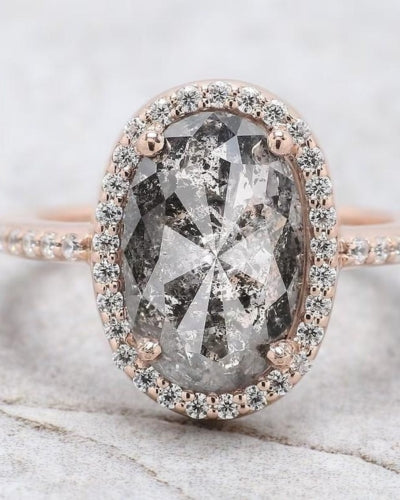
Salt and pepper diamonds usually display visible black, gray, or white inclusions and internal features. Their appearance can resemble a cloudy landscape, scattered flecks, smoke, or a miniature abstract pattern. No two stones necessarily share the same arrangement of internal features.
How salt and pepper diamonds differ from uniform fancy-color diamonds
A uniformly colored fancy diamond is often evaluated in terms of hue, tone, saturation, and the evenness of its color. A salt and pepper diamond is frequently chosen for its individual pattern, contrast, transparency, and overall character. Its inclusions are part of the aesthetic appeal, but the stone must still be evaluated for durability and suitability for its intended setting.
Popular shapes for salt and pepper diamonds
- Rose cut: A low-profile style with a domed crown and triangular facets, often suited to a soft, vintage-inspired appearance.
- Oval: An elongated silhouette that can create a balanced, elegant center stone.
- Pear: A teardrop shape that brings movement and a distinctive outline to rings and pendants.
- Hexagon: A geometric shape that suits contemporary and architectural designs.
- Kite: An angular silhouette for a bold, unconventional look.
- Marquise: An elongated pointed shape that can create a dramatic finger-lengthening effect.
- Cushion: A softened square or rectangular outline that blends geometric structure with rounded corners.
Choosing a salt and pepper diamond is partly an exercise in finding a pattern that feels personal. A buyer may prefer evenly distributed inclusions, strong black-and-white contrast, or a softer gray appearance. The cut should complement the natural features instead of relying only on a product name.
Natural loose salt and pepper diamond showing distinctive black and gray inclusions and rose-cut facets
Explore available styles through the salt and pepper diamond engagement ring collection for inspiration on how naturally included diamonds can be used in modern jewelry.
13. Red, Orange, Purple, and Other Rare Diamond Colors
Some of the rarest fancy-color diamonds display red, orange, purple, or unusual combinations of hues. Their scarcity and distinctive appearance have made them important to collectors and gemological researchers.
Red diamonds
Red diamonds are exceptionally rare. Some stones described as red have secondary purple or brown components, and the exact causes of color can be complex. Because so few red diamonds are documented, a confirmed example can attract considerable interest from collectors.
Orange diamonds
Orange diamonds may appear pure orange or contain yellow, brown, or other secondary hues. Their color can range from a soft apricot impression to an intense orange. A stone's actual grade and visual appearance matter more than a broad color label.
Purple and violet diamonds
Purple and violet diamonds occupy another unusual part of the fancy-color spectrum. Their appearance may be influenced by structural characteristics and other factors within the diamond. Some stones show mixed pink, blue, or gray components that create a complex overall hue.
Why rarity does not tell the entire story
Rare colors can be highly desirable, but rarity alone does not establish value. Size, color strength, clarity, cut, origin documentation, treatments, and buyer demand all matter. A smaller stone with a remarkable color may be more compelling to a collector than a larger stone with a less distinctive appearance, depending on individual priorities.
14. How Natural Diamonds Develop Color
Natural diamonds form under extreme pressure and temperature conditions deep within the Earth. Their color can be influenced by trace elements, structural irregularities, radiation exposure, and the geological conditions they experience during formation and later history.
The carbon crystal structure of a diamond is remarkably ordered, but small differences within that structure can affect how it interacts with light. These differences can influence which wavelengths of visible light are absorbed and which reach the viewer, producing the color we perceive.
Common causes of diamond color
| Color family | Possible contributing factors | What buyers should know |
|---|---|---|
| Yellow | Nitrogen-related features in the diamond structure | Color strength and hue can vary substantially. |
| Blue | Boron and other structural or defect-related factors | Not every blue-looking stone has the same color origin. |
| Pink to red | Structural deformation and related defects in many stones | Color mechanisms are complex and can vary. |
| Green | Natural radiation-related effects in some diamonds | Specialized testing may be needed to assess color origin. |
| Brown | Structural features and deformation-related effects | Warmth and depth of color influence the appearance. |
| Gray | Various structural features and impurities, depending on the stone | Gray can appear alone or alongside other hues. |
Natural color, treated color, and visual effects
Natural color develops through geological processes. Treated-color diamonds have undergone processes intended to change or enhance their appearance. Laboratory-grown diamonds are created in controlled environments and may also be produced in different colors.
These categories should be described clearly because they are not interchangeable. A photograph cannot reliably establish a diamond's origin or treatment status. Appropriate documentation and professional examination can help buyers understand what they are purchasing.
15. How Diamond Cutting Changed the History of Colored Diamonds
Diamond cutting has always influenced the relationship between a gemstone and light. Earlier cutting styles were shaped by the tools and knowledge available at the time. As techniques developed, cutters gained greater control over a diamond's proportions, facet arrangement, and face-up appearance.
In colored diamonds, cutting can influence the way color is distributed visually. Certain proportions may emphasize the body color, while other designs may prioritize brilliance, transparency, or a particular outline.
Rose cuts and antique character
Rose-cut diamonds have a domed crown formed by triangular facets and generally lack the deep pavilion associated with many modern brilliant cuts. Their appearance can be softer and more reflective of historical jewelry styles. Rose cuts are often chosen for their vintage character and the way they can display the natural personality of a diamond.
Modern fancy-color cutting
Specialized cutting approaches helped increase the visual impact of some fancy-color diamonds. Cutters can consider the rough crystal's natural color distribution, shape, weight retention, and the best way to present the finished stone. These decisions require balancing multiple factors rather than maximizing a single measurement.
Why shape and cut are not the same
Shape describes the outline of a diamond, such as oval, pear, round, or hexagon. Cut refers more broadly to the proportions, facet arrangement, symmetry, and craftsmanship that affect how the diamond performs visually. Two diamonds with the same outline can look very different because of their cut, depth, transparency, and natural features.
16. Colored Diamonds in the Modern Era
Modern colored diamond jewelry reflects a wider range of tastes than the traditional emphasis on near-colorless stones alone. Buyers can explore vivid fancy-color diamonds, muted champagne stones, natural gray diamonds, and salt and pepper diamonds with visible inclusions.
This diversity has expanded the possibilities for engagement rings and personal jewelry. Instead of selecting a gemstone solely because it follows a conventional standard, many buyers now consider color, silhouette, setting, craftsmanship, and personal significance together.
From formal luxury to personal expression
Some buyers prefer rare, intensely colored diamonds with formal documentation. Others are attracted to subtle hues and unusual inclusions that make each stone look different. These approaches are not mutually exclusive: luxury can be expressed through rarity and provenance, but it can also be expressed through thoughtful design and quality craftsmanship.
Online jewelry shopping has made it easier to compare styles, shapes, and settings. At the same time, buyers need to pay attention to image accuracy, color descriptions, dimensions, treatment disclosure, and return policies. Digital photographs are useful for initial comparison, but they should not replace clear product information.
17. The Argyle Mine and Pink Diamond History
The Argyle mine in Western Australia became a major milestone in the modern history of colored diamonds. It was known for large-scale diamond production and for producing a small but highly sought-after supply of pink and red diamonds.
The mine also helped popularize descriptive marketing terms for brown diamonds, including champagne and cognac. These names made it easier for consumers to recognize and discuss warm-colored diamonds that had not always received the same attention as other fancy colors.
Why the mine became historically significant
The Argyle story demonstrates how supply, marketing, cutting, and publicity can change the position of a gemstone in the luxury market. A limited source of rare stones can create strong collector interest, especially when the gemstones have distinctive colors and an identifiable production history.
Mining at Argyle ended in 2020. Its historical importance continues through existing stones, jewelry collections, documented sales, and the continuing interest of collectors in pink diamonds associated with the mine.
The closure also illustrates why buyers should avoid assuming that all diamonds in a particular color come from a single source. Colored diamonds can originate in different geological regions, and geographic origin should be claimed only when appropriately supported.
18. Famous Diamonds, Collectors, and the Auction Market
Exceptional diamonds have become famous through a combination of unusual color, size, documented ownership, craftsmanship, and public attention. The Hope Diamond, the Dresden Green, and other celebrated gemstones illustrate the way individual stones can acquire cultural importance over centuries.
Auctions have also helped make colored diamonds visible to a wider audience. Publicized sales demonstrate that exceptional gemstones can attract substantial competition among collectors. However, a headline price should not be treated as a universal benchmark for ordinary colored diamonds.
What makes a famous diamond valuable?
- Distinctive color: Hue, tone, saturation, and distribution contribute to visual appeal.
- Size and rarity: Large diamonds with exceptional color can be particularly unusual.
- Documentation: A credible history of ownership or origin can strengthen a stone's story.
- Craftsmanship: Cutting and setting can influence how the gemstone is presented.
- Market conditions: Collector demand and competition affect auction results.
- Public recognition: A well-known name or historical association can increase attention.
Most people purchasing a colored diamond for personal jewelry do not need a world-famous gemstone. A well-chosen stone can be meaningful because it suits the wearer, fits the intended budget, and works beautifully in a carefully designed setting.
19. The Evolution of Colored Diamond Jewelry
Colored diamond jewelry has evolved alongside changes in metalworking, gemstone cutting, fashion, and personal taste. Historic pieces often featured elaborate arrangements and decorative settings, while contemporary designs range from minimalist solitaires to sculptural statement jewelry.
Antique-inspired designs
Antique-inspired jewelry may include rose cuts, milgrain details, engraved metal, and delicate settings. These elements can complement brown, gray, and salt and pepper diamonds, especially when the goal is a romantic or heritage-inspired appearance.
Modern minimalist jewelry
Minimalist designs emphasize the stone's outline and natural color. A simple bezel or prong setting can give a colored diamond a clean, contemporary appearance. The design should protect the stone while allowing the selected features to remain visible.
Statement jewelry
Statement pieces use color, scale, or unusual geometry to attract attention. A vivid yellow center stone, a dramatic pear-shaped diamond, or a geometric gray diamond can become the focal point of a ring or pendant. Such designs require careful balance so that the setting supports rather than distracts from the gemstone.
Modern colored diamond jewelry designs including a pear-shaped ring, a geometric ring, and a minimalist pendant

Matching the stone to the wearer
The most successful design begins with the intended wearer rather than a trend. Consider daily activities, preferred metal color, hand proportions, desired maintenance, and whether the jewelry will be worn every day or reserved for special occasions.
20. The History and Modern Appeal of Colored Diamond Engagement Rings
Diamond engagement rings became associated with romance and commitment through changing customs, commercial traditions, and evolving jewelry styles. Colored diamonds offer a distinctive interpretation of this tradition by making the center stone's hue an important part of the design.
A pink diamond may provide a soft romantic appearance, while a yellow diamond offers warmth and brightness. A blue diamond creates a cool focal point, and a salt and pepper diamond can appeal to someone who prefers natural pattern and contrast over a uniform appearance.
Choosing a center stone for an engagement ring
Start by identifying the desired color family and visual style. Next, consider the stone's dimensions, shape, transparency, and visible inclusions. Finally, choose a setting that balances appearance with protection, comfort, and maintenance.
For daily wear, the design should account for the diamond's exposed edges and the way the ring may encounter hard surfaces. Pointed shapes such as pear and marquise cuts may need protective design features. A qualified jeweler can help determine a suitable setting for the specific stone.
Explore the salt and pepper engagement ring collection for examples of how distinctive natural diamonds can become the center of a personalized ring.
21. Natural, Treated, and Laboratory-Grown Colored Diamonds
Understanding a diamond's origin and treatment status is essential when buying colored diamond jewelry. The three broad categories below can look similar in a photograph but differ in how the color or gemstone was produced.
| Category | How it is produced | Key buying consideration |
|---|---|---|
| Natural-color diamond | Forms naturally with color developed through geological processes | Confirm the description and obtain suitable documentation for significant purchases. |
| Treated-color diamond | A natural diamond whose appearance has been modified by a treatment | Understand the treatment and ensure it is disclosed accurately. |
| Laboratory-grown colored diamond | Created in a controlled laboratory environment and produced with color characteristics | Confirm that laboratory origin is clearly stated. |
Why disclosure matters
Clear disclosure allows buyers to compare products on a fair basis. It also helps prevent confusion between a natural-color diamond and a diamond whose color was changed after formation. The right choice depends on the buyer's priorities, but the category should always be represented accurately.
For an important purchase, request a grading report or other suitable documentation from a qualified gemological laboratory where appropriate. Confirm that the report refers to the exact stone being sold, and check whether it addresses color origin, treatment, and identifying characteristics.
22. How Colored Diamonds Are Evaluated
Colored diamonds require an evaluation approach that considers their color alongside other characteristics. The importance of each factor varies according to the type of diamond, the design, and the purpose of the purchase.
Color hue, tone, and saturation
- Hue: The basic color family, such as yellow, pink, blue, or green.
- Tone: How light or dark the color appears.
- Saturation: The strength or intensity of the color.
- Distribution: How evenly or unevenly the color appears across the stone.
Two diamonds described as pink can look dramatically different because of their tone, saturation, secondary hues, and cut. The same is true of brown, yellow, and blue diamonds.
Clarity and inclusions
Clarity describes internal features and surface characteristics. Inclusions may be barely visible or obvious to the naked eye. In some styles, such as salt and pepper diamonds, visible inclusions are part of the desired appearance. Nevertheless, inclusions that affect durability should be evaluated carefully.
Carat weight and measurements
Carat measures weight, not the visible diameter or length of a diamond. Two stones with the same carat weight may have different face-up dimensions because of their shape and proportions. Compare actual measurements as well as weight when choosing a center stone.
Cut quality and craftsmanship
Cut affects the stone's proportions, light return, symmetry, and presentation. For colored diamonds, a suitable cut can help emphasize color while preserving an attractive shape. Inclusions, natural color distribution, and the rough crystal's original shape may influence the final cutting decision.
Documentation and identification
Reports and appraisals serve different purposes. A grading report documents specified gemological observations, while an appraisal estimates value for a defined purpose. Neither should be confused with a guarantee of future resale price. Always verify the scope and identity of any documentation provided.
23. Step-by-Step Guide to Buying a Colored Diamond
Buying a colored diamond becomes easier when the process is divided into clear decisions. The following steps help organize a purchase whether you are selecting a loose gemstone, an engagement ring, or a custom jewelry piece.
Step 1: Define the purpose
Decide whether the diamond is intended for daily wear, a special-occasion piece, a collector purchase, or a custom engagement ring. The intended use affects the preferred size, setting, and durability requirements.
Step 2: Choose a color family
Compare the appearance of pink, yellow, blue, green, brown, gray, and salt and pepper diamonds. Think about whether you prefer a strong, saturated color or a subtle, natural-looking hue. Review photographs in more than one lighting condition whenever possible.
Step 3: Establish a realistic budget
Set a total budget that includes the diamond, setting, metal, craftsmanship, applicable taxes, and any required documentation. Rare intense colors may cost substantially more than less saturated or more commonly available stones. Avoid assuming that carat weight alone determines price.
Step 4: Compare measurements and shape
Review length, width, depth, and overall outline. A pear-shaped diamond may look larger in one dimension than a round diamond of the same weight, while a deep-cut stone may have less face-up spread than expected.
Step 5: Ask about natural color and treatment
Request a clear written description of the diamond's origin and treatment status. If the distinction is important to your purchase, seek suitable independent documentation. Do not rely on a product title, stock photograph, or verbal description alone.
Step 6: Examine inclusions and durability
Review the location and appearance of visible inclusions. For salt and pepper diamonds, assess whether the internal pattern is attractive and whether any features could create durability concerns. A jeweler should consider the stone's structure before recommending a setting.
Step 7: Select the setting
Choose a setting that supports the diamond, complements its color, and suits the wearer's habits. Bezel settings can protect the perimeter of some stones, while prong settings can allow more of the diamond to remain visible. The best option depends on the individual stone and design.
Step 8: Review the complete purchase terms
Before paying, confirm the product description, metal purity, ring size, production timeline, shipping details, return policy, resizing terms, and any custom-order limitations. Keep the order details and documentation for future care or insurance needs.
Colored diamond buying checklist
- Confirm the diamond's stated color and appearance.
- Check natural, treated, or laboratory-grown status.
- Review carat weight and exact measurements.
- Understand clarity and visible inclusions.
- Compare photographs with the written description.
- Ask whether a grading report is available or appropriate.
- Choose a practical, secure setting.
- Review return, resizing, repair, and warranty terms.
- Retain invoices and relevant gemstone documentation.
24. Choosing a Jewelry Design for Colored Diamonds
The right design brings out the diamond's natural character while making the finished piece comfortable and wearable. Metal color, setting style, stone shape, and the scale of the design should be considered together.
Yellow gold
Yellow gold can create a harmonious, warm appearance with yellow, champagne, cognac, and some brown diamonds. It can also provide a striking contrast with blue or green stones. The final effect depends on the metal's tone and the diamond's hue.
Rose gold
Rose gold often complements warm brown diamonds, some pink diamonds, and vintage-inspired designs. Its soft, warm appearance can make a ring feel romantic without relying on elaborate decoration.
White gold and platinum
White metals can provide contrast with colored diamonds and suit minimalist or contemporary designs. They can help a colored center stone stand out visually, especially when the setting uses simple lines and limited additional decoration.
Choosing a setting style
| Setting style | Visual effect | Consideration |
|---|---|---|
| Solitaire | Emphasizes the center stone | Choose a secure structure suited to the diamond's shape. |
| Halo | Frames the center with smaller stones | Ensure the surrounding stones complement rather than overwhelm the color. |
| Bezel | Creates a clean outline around the stone | Confirm that the design suits the stone's proportions and edge profile. |
| Vintage-inspired | Adds heritage character through decorative details | Balance ornamentation with everyday comfort and maintenance. |
| Geometric | Emphasizes angular outlines and modern structure | Protect pointed corners and exposed edges where needed. |
Custom jewelry and individual expression
Custom jewelry offers flexibility in stone shape, metal color, setting height, accent stones, and personal details. It is particularly useful when the diamond has an unusual outline or distinctive natural inclusions that deserve a carefully planned setting.
Before a custom design is approved, confirm the exact center stone, its measurements, the intended metal, the ring size, and the proposed setting details. A design that looks attractive in a sketch must also work physically with the actual gemstone.
To explore a personalized design, visit the design-your-own engagement ring page and review the available customization process.
25. Colored Diamond Care and Maintenance
Diamonds are known for their hardness, but hardness does not make a gemstone impossible to damage. A diamond can chip if struck at a vulnerable angle, and a setting can loosen through everyday wear. Colored diamond jewelry should be cared for according to the specific stone and setting.
Everyday care
- Remove rings before heavy manual work, sports, or activities where the jewelry may receive an impact.
- Store each piece separately to reduce scratching between jewelry items.
- Inspect prongs, bezels, and other setting components periodically.
- Clean gently with suitable products recommended for the piece.
- Keep harsh chemicals away from jewelry unless a professional confirms that they are safe for the materials.
Cleaning a colored diamond
For many diamond pieces, lukewarm water, a mild cleaning solution, and a soft brush can help remove everyday residue. However, jewelry may contain other gemstones, delicate settings, coatings, or structural features that require special care. Avoid aggressive cleaning methods unless they are approved for the exact piece.
When to seek professional inspection
If a stone moves in its setting, a prong appears bent, or the ring receives a hard impact, have it inspected before continued wear. Professional inspection is especially important for rings worn daily because repeated contact can affect the setting over time.
26. What Influences the Value of Colored Diamonds?
The value of a colored diamond depends on several interacting characteristics. There is no single rule that applies equally to every color, shape, size, and quality level.
Color strength and visual appeal
For many fancy-color diamonds, color is a major value factor. A strong, attractive hue can be highly desirable, but the relationship between saturation and value varies by color category and market demand.
Rarity and availability
Some colors, particularly exceptional red, pink, and blue examples, are scarce. Brown and yellow diamonds are generally more common within the fancy-color market, although individual stones can still be rare because of their size, hue, or quality.
Carat weight and proportions
Larger diamonds are not simply scaled-up versions of smaller ones in terms of price. Weight, face-up dimensions, cut, color distribution, and clarity interact to influence desirability. A well-proportioned smaller stone may suit a particular ring design better than a heavier stone with less attractive dimensions.
Natural origin and treatment disclosure
Buyers should understand whether a diamond's color is natural, treated, or laboratory-grown. Accurate disclosure and suitable documentation help establish what is being purchased and support fair comparisons between stones.
Setting and craftsmanship
The finished jewelry piece has its own value beyond the center diamond. Metal purity, construction, design complexity, accent stones, finishing, and the quality of the setting all contribute to the final product.
Resale value and investment expectations
Colored diamonds should not be purchased with an assumption that their value will automatically increase. Future prices depend on changing market conditions, rarity, documentation, buyer demand, and the costs associated with selling. Jewelry purchased for personal meaning should be evaluated primarily against the buyer's preferences and budget.
27. Three Illustrative Colored Diamond Jewelry Case Studies
The following examples are illustrative design scenarios, not claims about specific customer transactions. They demonstrate how historical context and practical selection criteria can guide modern jewelry decisions.
Case study 1: A champagne diamond in a vintage-inspired ring
Design brief: A buyer wants a warm, understated engagement ring with a heritage-inspired appearance.
Stone choice: A champagne-colored diamond with an oval or cushion outline offers a soft golden-brown appearance. The buyer compares the actual hue, measurements, visible inclusions, and overall brightness rather than relying on the word champagne alone.
Setting choice: Rose gold or yellow gold can complement the stone's warmth. Subtle milgrain details or a simple bezel may provide a vintage character without creating an overly elaborate design.
Practical lesson: A coherent combination of stone color, metal tone, and setting detail can produce a distinctive ring without requiring a large center stone or an elaborate halo.
Case study 2: A salt and pepper diamond for an unconventional engagement ring
Design brief: A buyer prefers an individual stone with visible natural pattern instead of a uniform appearance.
Stone choice: A rose-cut pear or hexagonal salt and pepper diamond provides a recognizable silhouette and a distinctive inclusion pattern. The buyer checks the pattern under different lighting conditions and asks whether the inclusions or shape create durability concerns.
Setting choice: A protective setting can support vulnerable edges while allowing the main surface to remain visible. The metal may be selected to create contrast or maintain a muted, monochromatic look.
Practical lesson: The appeal of a salt and pepper diamond often comes from its individuality. Good selection requires understanding both the visual pattern and the stone's physical suitability for the intended use.
Case study 3: A colored diamond pendant as a personal heirloom
Design brief: A buyer wants a piece that can be worn regularly and eventually passed to a family member.
Stone choice: A yellow, blue, or brown diamond is selected according to the recipient's preferences and the intended budget. The buyer considers color, size, transparency, documentation, and how the stone will look when suspended in a pendant.
Setting choice: A secure pendant design balances the gemstone's visibility with protection. A simple chain and restrained setting can keep the piece versatile across different outfits.
Practical lesson: Jewelry becomes an heirloom through its combination of craftsmanship, personal meaning, care, and preservation. A documented purchase and suitable maintenance plan help support that long-term intention.
28. The Future of Colored Diamond Jewelry
The future of colored diamond jewelry will likely continue to reflect a mix of technological progress, changing tastes, design innovation, and consumer interest in individual gemstones. Natural fancy-color diamonds will remain distinctive because of their geological formation, scarcity in certain colors, and the stories associated with particular stones.
More personalized design
Buyers increasingly have opportunities to compare shapes, metal colors, settings, and center stones before choosing a finished piece. Custom design can help transform an unusual loose diamond into a ring, pendant, or other item that reflects the wearer's preferences.
Greater attention to transparency
Clear information about natural origin, treatments, dimensions, and documentation is essential as shoppers compare more products online. Accurate photography and specific descriptions help customers understand the appearance of the gemstone before making a purchase.
Appreciation for distinctive natural character
Luxury does not have to mean that every diamond looks identical. Champagne diamonds, natural gray stones, and salt and pepper diamonds demonstrate how color variation and visible inclusions can become central design features. Their appeal lies in the combination of a natural gemstone and thoughtful craftsmanship.
As styles evolve, the central attraction of colored diamonds remains the same: every stone has its own visual identity. The best jewelry designs respect that identity while making the gemstone comfortable, secure, and meaningful to the person who wears it.
Conclusion: From Ancient Treasures to Personal Heirlooms
The history of colored diamonds stretches from the historic diamond trade of India to royal collections, global mining discoveries, advances in cutting, and the modern world of personalized fine jewelry. Blue, pink, yellow, green, brown, and other colored diamonds each have distinctive histories shaped by geology, craftsmanship, rarity, and changing tastes.
Today, colored diamonds offer an extraordinary range of design possibilities. A vivid fancy-color diamond can become a statement of luxury, while a champagne stone or salt and pepper diamond can express a quieter, more individual aesthetic. Their beauty depends not only on rarity but also on the way each stone is selected, cut, set, and worn.
When choosing a colored diamond, begin with the appearance you love, then confirm the stone's measurements, treatment status, documentation, durability, and suitability for the intended design. A thoughtful selection process brings together the history of the gemstone and the personal story of the jewelry it becomes.
29. Frequently Asked Questions About Colored Diamond History
1. What is the history of colored diamonds?
Colored diamonds have been valued for centuries as rare gemstones and symbols of wealth, status, and personal distinction. India played a central role in the early diamond trade, while later discoveries in Brazil, southern Africa, Australia, and other regions expanded global supply. Advances in cutting and changing jewelry tastes helped establish colored diamonds as a distinct part of the modern luxury market.
2. Where were diamonds first discovered and traded?
India is recognized as a major early source of diamonds and was the principal supplier to many historical international markets for a long period. Diamonds were recovered from alluvial deposits and traded through networks linking the subcontinent with other regions. The precise timing of the earliest discovery is difficult to establish as a single event.
3. Why is India important in colored diamond history?
India's importance comes from its historic diamond deposits, trading networks, royal collections, and association with famous diamonds. The Golconda region became especially renowned. Many celebrated stones with Indian historical connections later entered international collections and helped shape the public imagination about diamonds.
4. What makes a diamond naturally colored?
Natural diamond color develops through geological processes involving factors such as trace elements, structural irregularities, and radiation-related effects. Different mechanisms can create different colors, and the cause may vary even among diamonds that look similar. Specialized examination may be required to assess color origin.
5. Which colored diamond is the rarest?
Red diamonds are among the rarest documented fancy-color diamonds. Exceptional pink, blue, green, and other colors can also be very scarce. Rarity depends on the precise color, intensity, size, and quality rather than on a simple ranking that applies to every stone.
6. Why are pink diamonds so famous?
Pink diamonds combine a distinctive color with a history of rarity and strong collector interest. Their visibility increased significantly through the modern production of pink diamonds at the Argyle mine in Australia. They remain popular for distinctive engagement rings and fine jewelry.
7. What is the history of champagne diamonds?
Champagne is a commercial description commonly used for selected brown diamonds with warm golden or brown tones. The term gained wider recognition during the late twentieth century as marketing helped draw attention to brown diamonds. It is not a substitute for a precise gemological description of an individual stone.
8. Are salt and pepper diamonds historically important?
Salt and pepper diamonds are part of the broader history of natural diamonds with visible inclusions and distinctive appearances. Their modern popularity reflects growing interest in individual patterns, unconventional engagement rings, and natural character. Their appeal is often aesthetic rather than based on intense, uniform body color.
9. How did colored diamond engagement rings become popular?
Colored diamond engagement rings grew in visibility as consumers explored alternatives to traditional colorless center stones. Famous colored diamonds, changes in jewelry design, increased awareness of fancy colors, and demand for personal expression all contributed to their appeal. Popularity differs by color and market.
10. What is the difference between fancy-color and colorless diamonds?
Colorless and near-colorless diamonds are generally evaluated in a grading range where visible yellow or brown tint is an important factor. Fancy-color diamonds are evaluated using specialized descriptions of hue, tone, and saturation. Stronger color can be desirable in fancy-color diamonds, depending on the hue and other characteristics.
11. Are natural colored diamonds better than treated diamonds?
Neither category is automatically the best choice for every buyer. Natural-color diamonds develop their color through geological processes, while treated diamonds have undergone processes that change their appearance. The important considerations are accurate disclosure, personal priorities, documentation, quality, and budget.
12. Are laboratory-grown colored diamonds real diamonds?
Laboratory-grown diamonds have a diamond crystal structure and are diamonds, but they are created in controlled laboratory environments rather than formed naturally in the Earth. Their origin should be disclosed accurately, and they should not be represented as natural diamonds.
13. Does a colored diamond's carat weight determine its price?
No. Carat weight is one factor among several. Color, saturation, clarity, cut, shape, rarity, treatment status, documentation, and market demand can all affect price. Two diamonds with the same carat weight may differ substantially in appearance and value.
14. Which metal is best for a colored diamond ring?
The best metal depends on the diamond's color and the wearer's style. Yellow gold can complement warm brown and yellow hues, rose gold often suits warm or romantic designs, and white metals can create contrast. The setting must also provide appropriate support for the particular diamond.
15. Can colored diamonds be worn every day?
Many colored diamonds can be used in everyday jewelry when the stone is suitable for the design and securely set. Hardness does not make diamonds immune to chipping or damage. Setting style, exposed edges, activities, and routine inspection all affect long-term wearability.
16. What should I check before buying a natural colored diamond?
Check the color description, natural or treated status, measurements, carat weight, visible inclusions, cut, setting suitability, and return terms. For significant purchases, ask whether suitable independent documentation is available and confirm that it identifies the exact gemstone being offered.
17. Why is the Argyle mine important to diamond history?
The Argyle mine in Western Australia became an important source of diamonds, including a small but highly sought-after supply of pink and red stones. It also helped popularize commercial descriptions for brown diamonds. Mining ended in 2020, making its production history particularly relevant to collectors of associated stones.
18. Do colored diamonds always have better resale value?
No. Some rare, exceptional colored diamonds attract strong collector interest, but resale value is not guaranteed. Market conditions, quality, documentation, treatment status, buyer demand, and selling costs all matter. A purchase should not be treated as a guaranteed investment.
19. How should I care for a colored diamond ring?
Clean the ring gently using methods suitable for its materials, store it separately from other jewelry, and inspect the setting regularly. Remove it during activities that may cause hard impacts. If the stone moves or the setting appears damaged, arrange a professional inspection.
20. Can I create a custom colored diamond engagement ring?
Yes. Custom designs can combine a chosen diamond shape and color with a preferred metal, setting style, and personal details. Before approving the design, confirm the center stone's measurements, ring size, metal specifications, setting structure, production timeline, and order terms.


Hinterlasse einen Kommentar
Diese Website ist durch hCaptcha geschützt und es gelten die allgemeinen Geschäftsbedingungen und Datenschutzbestimmungen von hCaptcha.