How to Choose the Right Cut & Setting for Salt & Pepper Earrings
Everything you need — from shape anatomy to metal pairings, pros & cons, real studio case studies, and a step-by-step buying checklist that ensures you leave with earrings you’ll wear daily.
Salt and pepper diamond earrings — a close-up of textured grey diamond studs in gold bezels
Quick TL;DR
Choose the cut based on the visual effect you want: round/oval for classic face-up size, hexagon/pear for geometric or elongated looks, and fancy cuts (pentagon, marquise) for unique silhouettes.
Choose the setting to balance protection and style: bezels protect points, prongs maximize light, halos increase perceived size, and micro-pavé amplifies sparkle.
Match metal with tone — warm metals for warm salt & pepper contrast, white metals for cooler looks; platinum for daily-wear durability.
Always request multiple-angle photos, ask about mounting (bezel vs prong) and confirm sizing with millimetres for face-up appearance.
Why Choose Salt & Pepper Diamond Earrings?
Salt & pepper diamonds are natural diamonds with visible black and white inclusions dispersed throughout the stone. This speckled 'galaxy' effect makes each stone unique and particularly well-suited for jewelry that celebrates texture and personality rather than flawless brilliance.
Three reasons collectors pick salt & pepper diamond earrings
Unique look: No two stones are the same — perfect for distinctive stud or drop earring designs.
Value proposition: Salt & pepper stones often offer larger face-up appearance for lower price compared to eye-clean diamonds.
Versatility: They work beautifully in contemporary, vintage, rustic, and minimal designs.
Related reads on styling and metal pairings: explore curated design inspiration and recommended metal matchups in FancyDiamondJewels’ design ideas and metals guide.
Cut Overview — How Shape Changes Character
The cut of a diamond determines its silhouette, faceting pattern, and how light interacts with its inclusions. For salt & pepper diamonds, the choice of cut is often less about maximum sparkle and more about how inclusions are distributed and showcased.
Cut factors that matter for salt & pepper earrings
Face-up size: Some cuts (hexagon, oval) show more surface area relative to their carat weight.
Facet layout: Large facets may reveal inclusion patterns dramatically; smaller facets (brilliant styles) break light into flashes, masking inclusions slightly.
Points and edges: Cuts with points (marquise, pear, pentagon) need protective settings.
Comparison of diamond cuts for salt and pepper earrings: round, Cushion, pear, hexagon, marquise, Round Rose Cut
Popular Cuts for Salt & Pepper Earrings
Round & Round Brilliant
Classic, well-balanced, and excellent for studs. Round cuts provide a clean, circular face-up that often minimizes the apparent density of inclusions, making them a versatile pick for everyday studs.
Oval
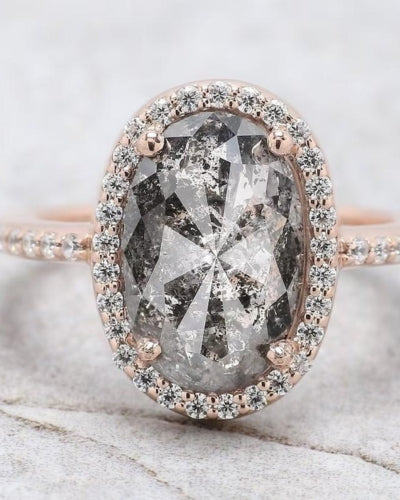
Oval stones give an elongated face-up that appears larger and offers graceful lines for drop or halo earrings.
Pear
Pear-shaped salt & pepper diamonds create a teardrop silhouette that's ideal for dangly earrings or elegant studs with a directional focus.
Hexagon
A geometric favorite for modern vintage looks. Hexagons pair beautifully with halos and micro-pavé for amplified presence.
Marquise
Streamlined and dramatic; excellent for elongating the ear when used in drops or linear earring designs.
See a deep-dive comparison of pentagon vs hexagon guides and performance in practical settings on FancyDiamondJewels.
Setting Overview — Protection vs Presentation
Settings decide how much of the diamond is visible, how protected it is, and how the light behaves. For salt & pepper diamonds, settings also influence whether the inclusion pattern becomes the star or remains a textured backdrop.
Common setting choices
Bezel — Full or partial bezels encircle the stone in metal, offering maximum protection and a modern, framed look.
Prong — Classic prong settings let more light through and give a lighter appearance; require careful prong design for pointed shapes.
Halo — Surrounding melee or micro-halo can increase perceived size and create contrast, making inclusions sit in a glittering field.
Flush — For studs, flush or gypsy settings create a seamless surface for durable wear.
Micro-pavé accents — Add sparkle around or on the face of the earring but require attention to clarity choices for tiny stones. (See FancyDiamondJewels’ micro-pavé guide for details.)
Bezel, prong, halo settings for salt and pepper diamond earrings
Best Settings by Shape — A Practical Match-Making Table
Shape
Recommended Settings
Why it works
Round
Prong, Bezel, Halo
Classic silhouette, balanced stress distribution.
Oval
Bezel, Halo, Prong with V-tip protection
Elongated face-up; bezel protects long edges.
Pear / Marquise
V-prong, Partial bezel, Halo
Points need reinforcement to avoid chipping.
Hexagon
Bezel, Hex-halo, Micro-pavé shoulders
Symmetry pairs perfectly with haloes and geometric frames.
Pentagon & Fancy
Custom bezel, Mixed prong/bezel hybrid
Unique points need custom support and protective metalwork.
Metal Pairings & Visual Effects
Metal choice affects warmth, contrast, and longevity. Below are practical pairings:
Yellow gold: Warmer backdrop, makes peppered inclusions pop; ideal for vintage looks.
Rose gold: Romantic and soft — pairs well with brownish or warm-toned speckles.
White gold / Platinum: Cooler & modern; white metals create a cleaner, more neutral halo effect that emphasizes shape and sparkle contrast.
Durability note
Platinum offers superior resilience for daily-wear studs and hoops; gold alloys can be hardened (e.g., 14k) for longevity while maintaining color choice.
Daily Wear Considerations & Durability
If you plan to wear your salt & pepper earrings every day, prioritize these elements:
Low-profile settings (bezel or flush) to avoid snagging on clothing.
Secure closures on earring backs — screw-backs or locking backs for studs, hinged clasps for hoops.
Protective mounting for pointed cuts (pear, marquise, pentagon) — V-prongs or bezels recommended.
Hardness advantage: Diamonds are a 10 on Mohs scale — but inclusions near edges can create weak points; set carefully.
Close-up of secure bezel setting on salt and pepper diamond earring — designed for everyday wear
Recommended daily-wear configuration
Choose a face-up size you are comfortable with (measure mm, not just carat).
Prefer low-profile bezels or secure prongs for studs.
For drops, ensure the connector is soldered and tested for stress points.
Step-by-Step Visual Buying Checklist
Use this checklist when viewing stones online or in the studio. Always request the following before purchase:
Multiple-angle photos — top, side, pavilion, and bezel-on angles.
Scale shots — place near a millimetre ruler.
Face-up mm measurements and carat weight confirmation.
Zoomed images of inclusion pattern at 10x or close-up macro photos.
Video of the stone in natural light to assess how the pattern reads while moving.
Mount mock-up — CAD render or sample photo showing the stone in the intended setting.
Return policy & resizing terms — essential for earring posts and backs.
Quick pro tip: ask to see the stone both naked (loose) and mounted in the exact earring setting you want. Mounting changes how inclusions read dramatically.
Photos & Videos to Request from the Seller
Here’s a minimal required media list to evaluate a salt & pepper earring stone/setting:
Top-down face-up photo at 1:1 crop (macro).
Side profile showing depth and culet relationships.
Pavilion view to inspect inclusions near the girdle.
Scale photo with a ruler or coin.
Short video (5–10 seconds) rotating slowly under daylight.
FancyDiamondJewels product pages often include multiple-angle images and in-studio styling — use those details when available on the product listing or request custom photos for bespoke pieces.
Use the matrix below to narrow your choice quickly:
If you want maximum protection & a vintage framed look → choose a bezel in warm metal.
If you want maximum face-up and sparkle → choose prongs or halo.
If you plan to wear daily and prefer low snagging → choose flush or bezel.
Case Studies & Studio Notes (E-E-A-T Friendly)
Case Study 1 — "The Bold Bride": Pentagon center with partial bezel
Scenario: Client wanted a statement pair of matching pentagon salt & pepper studs to wear at events.
Design choice: Low partial bezels with open gallery to show side facet play and hand-engraved shoulders. Metal: 14k yellow gold to accentuate warm speckles.
Outcome: The pentagon silhouette read dramatically in photos; partial bezel protected points while showcasing the unique inclusion pattern.
Case Study 2 — "Daily Minimalist": Hexagon with micro-halo studs
Scenario: A client wanted everyday studs that felt unique but understated.
Design choice: Hexagon centers in white gold with tight micro-halo and secure screw-back posts.
Outcome: The halo increased perceived size and softened the salt & pepper texture, producing an elegant, wearable stud.
These examples are adapted from real studio design notes and product showcases available through the FancyDiamondJewels design features and blog case studies.
Pros & Cons: Cuts and Settings for Salt & Pepper Earrings
Pros
Unique, character-filled appearance that stands out.
Often more affordable face-up size for budget-conscious buyers.
Flexible design language — works with vintage, rustic, and modern styles.
Cons
Inclusions can concentrate near girdles or edges; choose settings to compensate.
Rarely accompanied by GIA-style certificates — rely on seller transparency and photos.
Some buyers prefer eye-clean brilliance; salt & pepper diamonds are intentionally textured.
Care, Cleaning & Insurance
Salt & pepper diamonds are diamonds — durable — but their inclusions may trap dirt and make the stone look dull if not cleaned. Follow these guidelines:
Clean with warm water, mild dish soap and a soft toothbrush; rinse thoroughly.
Avoid harsh chemicals or acids that dull metal or loosen settings.
Store separately or in soft pouches to prevent metal abrasion.
Insure high-value or sentimentally important pieces; keep images and receipts on file.
If the earrings include micro-pavé or tiny melee stones, professional cleaning is recommended yearly to prevent buildup and to check for loose accents.
Step-by-Step Buying Guide — From Choice to Purchase
Decide on silhouette: Pick the shape that matches the wearer’s style
Choose the setting: Select bezel for protection, prong/halo for face-up size and sparkle.
Confirm metal: Pick metal for tone and wear (14k vs 18k vs platinum).
Request media: Ask for multiple photos and video
Ask about returns: Verify return and resizing policy for posts and backs.
Order a mock-up: For bespoke designs, request CAD or a physical mock if budget allows.
Post-purchase care: Schedule a professional check after 6–12 months.
Checklist you can copy:
✔ Shape chosen: ____________
✔ Setting chosen: ____________
✔ Metal chosen: ____________
✔ Photos requested: Top / Side / Video
✔ Return window: ___________
✔ Seller contact & SKU: ___________
Infographic — Quick Visual Summary
Replace the placeholder below with a web-optimized WebP infographic that summarizes this guide for your product page or social channels.
Infographic summarizing how to choose cut and setting for salt and pepper diamond earrings
SEO & On-Page Tips for Your Product Pages (Shopify Ready)
Use descriptive titles (e.g., "Round Salt & Pepper Diamond Studs — 0.50 CT, 14k Rose Gold").
Include face-up mm and carat weight in the first paragraph of the product description.
Upload multiple WebP images with descriptive alt text (e.g., "0.50ct round salt and pepper diamond stud 14k rose gold bezel").
Use structured data JSON-LD for product price, availability, SKU, and review snippets (see JSON-LD below).
Common Mistakes to Avoid
Buying from listings with a single photo — always request more angles.
Choosing a pointed cut with minimal protection — points should be reinforced.
Ignoring post/back security — cheap backs on studs risk losing an earring.
Questions to Ask Your Jeweler Before You Buy
Can I see high-resolution images and a short video of the exact stones mounted in the setting?
What is the exact face-up mm measurement (length x width) for each earring stone?
Will the setting be soldered and tested for stress points?
What is the return policy and warranty on posts and backs?
Do you offer screw-backs or locking backs for studs?
Use the jeweler’s answers to determine if the piece is studio-grade or a mass-market assembly.
Accessibility & Sizing Guidance
When listing or choosing earrings, include clear sizing in millimetres and note closure types for users with dexterity concerns. Consider offering alternative closures (leverbacks, kidney wires, or magnetic findings) for customers who prefer them.
Ready to Shop or Custom Design?
Explore the salt & pepper earring collection or request a bespoke consultation for custom settings and CAD previews.
Salt & pepper diamonds are natural diamonds with visible inclusions of black and white crystals, clouds or feathers that create a speckled, galaxy-like appearance.
Are salt & pepper diamonds durable enough for everyday earrings?
Yes — diamonds are very hard. However, inclusions near edges can create weak areas. Choose protective settings (bezel, V-prong) for pointed cuts and check mounting regularly.
Which setting makes salt & pepper earrings look bigger?
Halos and micro-pavé increase perceived size; bezel settings can make stones appear more framed and bold. Face-up mm measurements matter more than carat weight for perceived size.
Do salt & pepper diamonds come with certificates?
Many salt & pepper diamonds are not offered with traditional GIA certificates; instead sellers provide detailed photos, measurements, and studio notes. Ask the seller for all available documentation.
What metal should I choose for salt & pepper earrings?
Choose metal by desired contrast: yellow/rose gold for warmth, white gold/platinum for modern neutral looks. Platinum offers excellent durability for daily wear.
How should I clean my salt & pepper earrings?
Soak in warm water with mild dish soap, gently scrub with a soft toothbrush, rinse and dry. For micro-pavé or intricate metalwork, professional cleaning is recommended.
Are geometric cuts like hexagon or pentagon harder to set?
They can require custom settings to secure points and ensure symmetry. Work with an experienced bench jeweler for these cuts.
Can salt & pepper earrings be resized or altered later?
Earrings typically don't require resizing like rings, but settings can be modified. For drop earrings, link length can be adjusted; studs can be remounted into new settings if necessary.
Should I choose a bezel or prong for studs?
Bezel settings are excellent for protection and low snagging. Prongs maximize visible face-up and can feel more delicate; choose protective prongs for pointed or fragile stones.
How do I ensure a secure backing for everyday wear?
Opt for screw-backs or locking backs for studs; for hoops choose high-quality hinged clasps or pressure locks and test the mechanism before regular wear.
Final Notes & Next Steps
Choosing the right cut and setting for salt & pepper diamond earrings blends creative intent with practical protection. Start by deciding whether the stone should be the focal point (choose dramatic cuts and open settings) or part of a composed design (choose haloed or framed looks). Always request multiple-angle media and verify the mounting details before purchase.
For gallery-quality pieces or bespoke runs, professional CAD mock-ups and studio photos are invaluable. FancyDiamondJewels regularly publishes design case notes and product pages showing multiple angles — use those resources when selecting pieces or requesting custom work.
Want help designing a bespoke pair? Contact the studio through the collection pages and request a custom consultation with CAD previews and mockups.



Leave a comment
This site is protected by hCaptcha and the hCaptcha Privacy Policy and Terms of Service apply.