
Why choose a radiant cut moissanite?

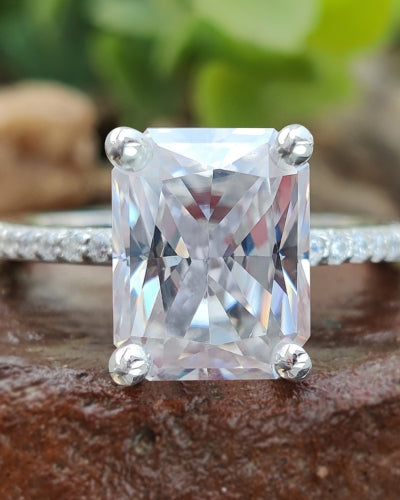
Radiant cut moissanite blends the elegant outline of an emerald or square step cut with a brilliant-style facet pattern. The result is a stone that reflects light in broad flashes and scintillating sparkle — ideal for an engagement ring where brilliance and a contemporary silhouette matter.
Radiant cuts are popular because they:
- Hide color and inclusions well thanks to its faceting.
- Create a modern, geometric footprint on the finger.
- Work beautifully in both solitaire and halo settings.
Example radiant moissanite rings can be found in curated collections — explore radiant and moissanite options in the Moissanite Engagement Rings collection and the Radiant Cut Rings collection for inspiration.
Top setting types — at a glance
Which setting is right for different lifestyles?
| Setting | Best for | Look |
|---|---|---|
| 4/6-Prong Solitaire | Everyday wearers who want classic sparkle | Minimal, timeless |
| Bezel / Partial Bezel | Active lifestyles, low profile | Modern, protective |
| Halo (Micro / Single) | Max sparkle and perceived size | Glamorous, vintage or modern |
| Cathedral / Elevated | Showcases the stone; elegant profile | Dressy, pronounced |
| Tension / Contemporary | Modern aesthetics; statement pieces | Sleek, minimal |
Prong & Solitaire settings — the classic choice

Why prongs work for radiant cuts
Prongs expose the moissanite to maximum light and therefore maximize brilliance. For radiant shapes, four or six prongs are common: four for a cleaner silhouette and six for added security.
Design tips
- Prong thickness: Slim prongs look delicate but choose slightly thicker prongs for moissanite to avoid bending over time.
- Platinum vs gold: Platinum holds prongs securely, but 14K gold (white, rose or yellow) gives warmth and is easier to size.
- Head height: A mid-height head balances wearability with visibility; avoid very high heads if you want low profile.
Shop examples
See practical prong-mounted radiant moissanite options in the product range (solitaire and claw-prong examples are listed on FancyDiamondJewels product pages).
Bezel & Partial Bezel — security first

Bezel settings surround the stone with metal, offering excellent protection for corners of radiant cuts (which can be vulnerable). Partial bezels (open bezels) combine safety with more light entry than a full bezel.
When to choose bezel
- Active jobs or hobbies (athletes, chefs, gardeners).
- If you prefer a modern, sleek silhouette.
- When you need a low-profile ring for stacking.
Design notes
For radiant shapes, ensure the bezel is cut to allow the signature radiant corners to read visually; ask your jeweler for scalloped bezels or chamfered corners to retain the shape's character.
Halo settings — amplify size and sparkle

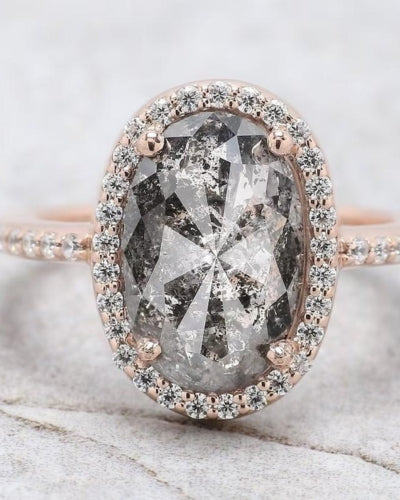
Halo settings surround the radiant center with smaller stones (pavé or micro-pavé), creating a larger face-up appearance and magnified brilliance. A well-designed halo also protects the center stone’s edges.
Halo styles for radiant cuts
- Single halo: Classic, a single ring of stones around the center.
- Double halo: Extra dramatic and adds visual weight.
- Square halo: Mirrors the radiant outline for cohesive geometry.
Practical tip
When choosing a halo, match the size and shape of fillers to the center to avoid overpowering the radiant cut's lines; tapered baguettes or small rounds both pair well depending on the look.
Cathedral & Elevated settings — showstage for the stone

Cathedral settings lift the stone with arches of metal on either side. This elevation is great for showing off the radiant facets and for rings intended to be the focal point.
- Good for statement engagement rings.
- Make sure the elevated profile still suits daily activities — consider a lower cathedral if you’re active.
Tension & Modern settings — for a contemporary statement

Tension settings trap the stone between two metal arms, giving the appearance that it floats. They are striking for radiant cuts but require precise engineering and regular checks.
Risks & rewards
- Reward: Ultra-modern look and open light entry.
- Risk: Metal fatigue or accidental knocks — choose reputable makers and robust metals (e.g., platinum or high-karat gold alloys engineered for strength).
Three-stone & Toi-et-Moi — narrative and balance

Three-stone settings pair a radiant center with side stones (trapezoids, baguettes or smaller brilliants) to create a balanced, tapered look. Toi-et-Moi (two-stone) styles are a romantic alternative and can pair a radiant with a contrasting shape.
When to choose side stones
- To accentuate the center's size without a halo.
- To introduce color contrast using sapphires or colored moissanite.
Pavé, Micro-pavé & Side-stone settings — fine detail

Pavé settings add shimmer to the band and shoulders. Micro-pavé uses very small stones for a continuous sparkle; however, the smaller the stones, the more delicate the setting. For longevity, ensure stones are well-set with sturdy rails.
Metal choices & finishes — how metal affects the look
Common options
- Platinum: Very durable, hypoallergenic, holds prongs tightly — slightly cooler in tone.
- 14K / 18K White Gold: On-trend, bright white finish (may require rhodium plating over time).
- Rose Gold: Warm, romantic; pairs nicely with warmer color moissanites.
- Yellow Gold: Classic, vintage-friendly; gives contrast to a colorless moissanite.
Finishes & texture
Polished, matte, hammered or brushed finishes dramatically change the ring's personality. High-polish shows off sparkle; matte gives a subtle, contemporary look.
Proportions, table size & ring measurements

When setting a radiant cut, control the table percentage and depth so the stone remains lively. A slightly shallower depth with a properly faceted pavilion keeps brilliance high. Always ask for measured dimensions (mm), table %, and depth % when buying loose moissanite or custom-setting a stone.
Key specs to request:
- Exact millimeter dimensions (length x width)
- Table % and depth %
- Cut grade or faceting description
Durability, repair & care
Daily wear considerations
Moissanite is durable (near diamond on hardness scale) but settings still determine real-world longevity. Regularly check prongs, ensure bezels are not dented, and re-tighten pavé stones as required.
Cleaning & maintenance
- Soak in warm soapy water weekly and gently brush with a soft toothbrush.
- Have prongs inspected every 6–12 months.
- Store rings separately to avoid metal-on-metal scratching.
Styling & matching wedding bands
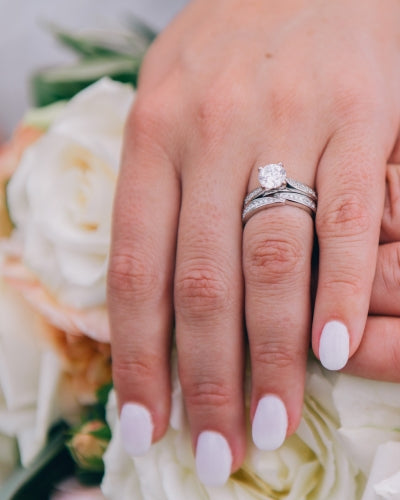
Match the band thickness and metal tone for a cohesive bridal set. For radiant centers, tapered half-eternity bands or curved contour bands complement the stone footprint effectively.
Case studies & examples
Case Study 1 — Minimal everyday solitaire
Client wanted a low-maintenance, elegant ring for everyday wear. We recommended a 4-prong mid-head solitaire in 14K gold with slightly thicker prongs and a flush-fit wedding band. Result: excellent daily comfort and ease of cleaning.
Case Study 2 — Glamorous halo for maximum impact
Client preferred a dramatic look with a smaller budget center stone. We selected a radiant moissanite with a single halo and micro-pavé shoulders to double perceived size and visibility while keeping the center 1.2–1.5 CT equivalent.
Browse similar styles and product layouts in FancyDiamondJewels' radiant and moissanite collections for real product references and photos.
Comparison: Top settings for radiant moissanite (detailed)
| Setting | Sparkle | Security | Maintenance |
|---|---|---|---|
| 4-Prong Solitaire | High | Medium | Low |
| 6-Prong Solitaire | High | High | Low |
| Bezel | Medium | Very High | Very Low |
| Halo | Very High | Medium | Medium (micro stones) |
| Tension | High | Variable | Requires professional checks |
Step-by-step guide to choosing the right setting
- Decide lifestyle needs: active vs occasional wear.
- Choose silhouette: classic, modern, vintage.
- Pick metal: platinum for durability, 14K/18K for color choices.
- Choose a setting family: prong, bezel, halo, etc.
- Match ring and wedding band: ensure flush or contoured fit.
- Check return/resizing policy: confirm 30-day returns & resize rules before finalizing.
Sample product pages and real ring models are available in FancyDiamondJewels' Moissanite Engagement Rings collection for hands-on comparison.
Pros & Cons — quick reference
Bezel
- Pros: Maximum protection, low-profile, waterproof-friendly.
- Cons: Slightly reduced brilliance, heavier metal look.
Halo
- Pros: Maximized visual size, lots of sparkle.
- Cons: More maintenance (small stones), can trap dirt.
Prong
- Pros: Maximum light, classic look, easier to clean.
- Cons: Prongs can catch; require occasional tightening.
E-E-A-T — Real-experience paragraphs
Experience: Jewelers and bench setters consistently recommend slightly thicker prongs for radiant-shaped centers because the cut's corners can be stress points when thin prongs are used. Many bench-tested repair records show thicker prongs reduce the frequency of re-tipping work in daily wear rings.
Expertise: Professional setters advise matching bezel contours to the radiant outline to keep the profile geometric rather than rounded — this preserves the stone's character and visual appeal.
Authoritativeness: When in doubt, ask to see detailed photos of the setting from multiple angles and request measurements; reputable shops display in-depth product photos and sizing information.
Trustworthiness: Confirm warranty, resizing and return policies at checkout. FancyDiamondJewels lists shop policies and product guarantees on their product pages and policy sections for easy verification.
Product references and policy pages are available on FancyDiamondJewels for verification and comparison.
Infographic — visual summary
Use this infographic as a printable one-page cheat sheet for ring settings.
Infographic: Choosing settings for radiant moissanite - infographic placeholder
FAQs — quick answers (schema-ready details)
Are radiant cuts a good choice for moissanite?
Yes — radiant cuts are excellent with moissanite because they combine facet brilliance and a square/rectangular outline that hides color well.
Which setting shows the most sparkle?
A halo setting typically increases sparkle and perceived size; however, a well-made prong solitaire also allows maximum light for brilliance.
Is bezel better for active wear?
Yes — bezel and partial bezel settings are the most protective and are recommended for active lifestyles.
How many prongs should I choose for a radiant cut?
Four prongs for a sleeker look; six for extra security. Thicker prongs add durability at a slight cost to delicacy.
Do halos make the ring harder to clean?
Micro-pavé halos can trap dirt and require regular cleaning; simple single-stone halos are easier to maintain.
Can I get a tension setting for moissanite?
Yes, but only from experienced makers — the metal must be strong, and regular professional checks are recommended.
What metal is best for everyday wear?
Platinum and 14K gold are excellent; platinum offers slightly better durability but at higher cost.
Does the radiant cut look bigger than round?
Perceived size depends on face-up dimensions; radiant cuts often look larger for the same carat weight due to their spread.
How often should I have the ring inspected?
Every 6–12 months is a sensible interval for prong checks and cleaning; sooner if you notice loose stones or catching.
Can I stack wedding bands with a cathedral setting?
Yes — choose a contoured or tapered band to sit flush beneath a cathedral head for a seamless look.
Ready to explore radiant moissanite rings?
Browse curated radiant moissanite rings and settings to find your perfect match. FancyDiamondJewels features a wide selection of radiant and moissanite engagement rings to inspire your design or purchase decision.


.%0A%0AMost%20sparkle:%20Halo%20(micro-pave%20halo%20with%20cathedral%20shank).%0A%0ASafest%20low-profile:%20Bezel%20or%20partial%20...)
Leave a comment
This site is protected by hCaptcha and the hCaptcha Privacy Policy and Terms of Service apply.