
The Ultimate Guide to Buying Princess Cut Diamond Rings
In a hurry? Princess cut diamonds combine modern elegance with great sparkle and a clean silhouette. This guide walks you — step-by-step — through choosing the ideal princess cut ring: how to read specs, pick settings, compare value, avoid common mistakes, and confidently buy from FancyDiamondJewels. (Includes quick-check tables, comparison charts, real-experience notes, and 10+ FAQs.)
Explore princess cut pieces at FancyDiamondJewels: Princess Cut engagement ring (product) — and browse the full engagement rings collection Lab Grown Diamond Engagement Rings and All Products.
Table of Contents
- Why Choose a Princess Cut?
- Princess Cut Basics — shape, facets, and brilliance
- How the 4Cs apply to Princess Cut
- Best Settings for Princess Cut Rings
- Budgeting & Value: Lab-grown vs Natural
- Step-by-step Buying Checklist
- Comparison charts & tables
- Case Studies & Real Experience
- Care & Maintenance
- FAQs
- Where to Buy — CTAs
Why Choose a Princess Cut?
The princess cut is the most popular square/rectangular brilliant cut. It offers modern geometry, high sparkle, and excellent value-per-carat because cutting yields are better than for many fancy shapes. If you want a clean, contemporary look with lots of sparkle and a crisp silhouette that pairs well with both modern and vintage settings, princess cut is a top pick.
Key reasons buyers choose princess
- Squared silhouette with sharp corners for a modern aesthetic.
- Excellent brilliance due to brilliant-style faceting (lots of sparkle).
- Efficient yield from rough stones — generally better price per carat.
- Versatile: looks great in solitaires, halos, three-stone, and channel settings.
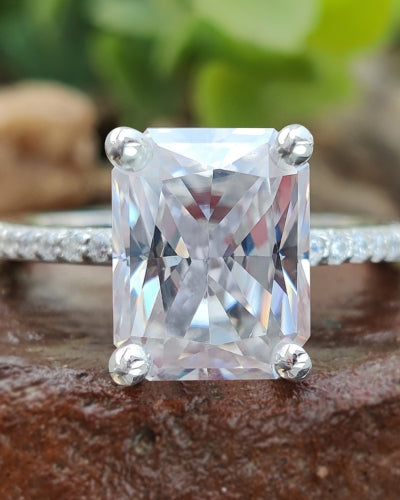
- Princess cut diamond engagement ring

Princess Cut Basics — Shape, Facets & Brilliance
The modern princess cut evolved in the 1960s–1980s as a square brilliant alternative to the round brilliant. It typically features a square or slightly rectangular face, brilliant-cut facets on the pavilion and crown, and sharp or slightly truncated corners to reduce chipping risk. Expect intense fire and scintillation when proportions are balanced.
What to look for in a princess cut stone
- Table %: For princess cut, most ideal tables range from ~61%–75% depending on faceting style.
- Depth %: Depth can vary; the visual balance and face-up size are impacted by depth. Aim for depths that optimize brightness without losing face-up size.
- Length-to-width ratio: Square looks near 1.00–1.03; slightly rectangular ~1.05–1.20.
- Symmetry & culet: Good symmetry ensures even sparkle; culet usually not a primary concern for princess cuts.
How the 4Cs Apply to Princess Cut Diamonds
All 4Cs — Cut, Color, Clarity, and Carat — apply, but princess cut emphasizes some specifics differently than rounds. Cut (proportions and polish) and clarity (because of facet pattern) are often the most important for princess cuts.
Cut
Unlike round brilliants, there is no single universal ideal cut table for princesses. Look for vendors who provide proportion diagrams or light performance images. Many fine sellers will list table %, depth %, and length/width ratios. If you can see a loupe image or actual light performance photos, prioritize balance: too deep = smaller face-up; too shallow = loss of brilliance.
Color
Because princess cuts have strong sparkle, they can mask slight color; however, corners can show tint. If you value icy white, target G–H for near-colorless, or F–G for stricter white. For yellow/gold settings, you can go a step lower (H–I) without obvious color on the finger.
Clarity
Princess cuts show inclusions differently than rounds because of their facet architecture. VS2–SI1 often offers the best value, but inspect for inclusions near corners or table. For smaller diamonds (<0.50 ct), SI clarity is usually perfectly fine.
Carat & Face-up Size
Because of depth variance, two princess cuts with the same carat weight may look different face-up. Ask for exact measurements (length x width x depth) to estimate visual size. Vendors that include table/depth and photos make comparison easy.
Quick 4Cs Cheatsheet for Princess Cut
| Aspect | Good Target | Notes |
|---|---|---|
| Cut (proportions) | Table 61–75% / balanced depth | Ask for diagrams or photos |
| Color | F–H (depends on setting) | Set choice affects perceived color |
| Clarity | VS2–SI1 for value | Watch for inclusions near corners |
| Carat | Pick by face-up mm | Check L x W x D for perceived size |
Best Settings for Princess Cut Rings
Because the princess cut has sharp corners, setting choice is important to protect those corners and to maximize the look. Here are the most common and effective settings.
1. Four-prong (corner) setting

Classic and minimal — leaves most light to the stone while protecting corners with prongs placed at each corner. Good for solitaires.
2. Bezel / Semi-bezel

Sleeker and highly protective — a bezel wraps the edge and guards corners. It reduces visible sparkle slightly but adds durability.
3. Halo setting

A halo of small stones makes a princess cut look larger and adds sparkle. Particularly effective if you want extra visual impact from a modest center carat.
4. Channel / Tiffany-style band

Princess cut pairs beautifully with straight-edged bands like channel-set diamonds or plain knife-edge bands.
Setting Comparison: Protection vs Sparkle
| Setting | Protection | Sparkle | Style |
|---|---|---|---|
| Corner prongs | Medium | High | Classic |
| Bezel | High | Medium | Modern |
| Halo | Medium | Very High | Glam |
| Channel | Medium-High | High | Timeless |
Budgeting & Value: Lab-Grown vs Natural Princess Cut Diamonds

Princess cut diamonds are available as both natural and lab-grown stones. Lab-grown diamonds often offer significantly better price-per-carat and allow buyers to trade up in size or color for the same budget. FancyDiamondJewels lists both lab-grown princess-cut designs and natural options across its collections.
Which should you pick?
- If your priority is size for budget: Lab-grown often gives more carat for the same spend.
- If you want natural provenance: Choose natural and expect higher price per carat.
- Resale: Natural diamonds can retain value differently; lab-grown currently trade differently in the secondary market.
Ready to explore actual princess-cut rings? View a sample product that’s a great example of a practical and budget-friendly princess solitaire — Princess Cut engagement ring — FancyDiamondJewels.
Browse Full CollectionStep-by-step Buying Checklist (Actionable)
- Decide your budget — set a maximum and a target. If you want larger face-up size, consider lab-grown options. (Tip: allocate 30–50% of the overall ring budget to the center stone.)
- Choose setting style — if you need durability, prioritize bezel or corner prongs; for maximum sparkle choose halo/solitaire with prongs.
- Pick Carat range — list target face-up mm based on finger size: 1.0–1.5 ct princess typically shows differently than round — check actual L×W measurements.
- Select Color/Clarity targets — for white metal (platinum/white gold) go F–H; for yellow/rose gold, H–I can be a sweet spot. Clarity: VS2–SI1 balance for most buyers.
- Ask for exact proportions & photos — request table, depth, L×W×D, and top/loupe photos.
- Confirm return & warranty policies — ensure 30-day returns and resize/repair options.
- Check certification & verification — for larger stones, look for GIA/IGI certificates or lab reports. FancyDiamondJewels offers verify-your-report tools for some orders.
- Order sample/similar and test — if unsure, order a lower-cost sample to check fit and style before committing to large custom purchases.
Examples, Comparison Charts & Pros / Cons
Typical buyer scenarios (examples)
- Budget-conscious trendsetter: 0.9–1.2 ct lab-grown princess, H color, SI1 clarity, halo setting — maximum visual size for price.
- Classic minimalist: 0.75–1.0 ct natural princess, G color, VS2 clarity, four-corner prong solitaire.
- Durability-first professional: 0.6–0.9 ct with bezel or semi-bezel set in platinum for heavy daily wear.
Pros & Cons of Princess Cut
| Pros | Cons |
|---|---|
| Modern, brilliant, efficient yield (value) | Sharp corners need protection |
| Pairs well with straight bands | Inclusions may be visible due to faceting pattern |
| Works well in halo/solitaire/three-stone | Cut-quality variability; no single 'ideal' standard |
Case Studies & Real-Experience Notes (E-E-A-T)
Case Study 1 — Upgrading to size with lab-grown
Client A wanted a 1.5 ct look on a moderate budget. By choosing a lab-grown princess with an H color / VS2 clarity and halo setting they achieved a face-up presence that matched a 1.5 ct natural look at a fraction of the cost. The ring arrived with full photos and a satisfaction guarantee.
Case Study 2 — Daily-wear durability
Client B works in an active environment. We recommended a semi-bezel setting in 18K gold with slightly truncated corners on the princess cut to minimize snagging and corner chips. After a year, the ring showed normal wear only; the client reported high satisfaction.
Infographic & Visuals (placeholders)
Use these visual placeholders in the Shopify theme; replace with optimized WebP assets for final publish. All images loaded lazily for page speed.
Infographic placeholder — princess cut proportion guide

Care, Insurance & Maintenance
Princess cuts are durable but corner-prone. Regular inspection (every 6–12 months) for prong integrity and professional cleaning keeps the stone secure and brilliant. For higher-value purchases, insure the ring under a jewelry rider or standalone policy.
Frequently Asked Questions
1. What is the best color grade for princess cut diamonds?
For white metals, target F–H for a bright white look. For yellow or rose gold settings, H–I often looks excellent while saving money.
2. Are princess cut diamonds more affordable than round brilliants?
Generally yes — princess cuts usually cost less per carat because more of the rough diamond is retained during cutting, resulting in better yield.
3. How do I protect the corners?
Choose corner prongs or a partial/full bezel. Check that the jeweler secures the corners and offers routine inspection.
4. What length-to-width ratio should I pick?
For a square appearance aim for 1.00–1.03. For a slightly rectangular look, 1.04–1.20 is common. Personal taste determines the ideal ratio.
5. Can I get a princess cut in lab-grown diamonds?
Yes — lab-grown princess cuts are widely available and typically more affordable, allowing upgrades in color, clarity, or carat for the same budget. FancyDiamondJewels features lab-grown engagement rings in specific collections. :contentReference[oaicite:5]{index=5}
6. Which settings make the princess look larger?
Halo settings and low-profile open galleries increase apparent size. A thin band with a halo can make the center look substantially larger visually.
7. How do I estimate face-up size from carat?
Face-up size depends on depth and proportions. Always ask for length × width × depth. Two stones with identical carat can appear different face-up due to depth variance.
8. Should I prioritize color or clarity?
For most princess cuts, prioritize cut quality and clarity (to avoid visible inclusions). Color can be balanced with the setting choice.
9. How long will a princess cut retain value?
Value retention depends on market trends, certificate, and whether the diamond is natural or lab-grown. Natural diamonds generally follow different resale patterns than lab-grown stones.
10. What if I need resizing or warranty?
Confirm the dealer's resize policy and warranty before purchase. FancyDiamondJewels lists policies and offers return/resize options on the product pages. :contentReference[oaicite:6]{index=6}
Final Checklist & Where to Buy
- Confirm exact L×W×D and table/depth percentages.
- Request multiple lighting photos or a video of the stone.
- Check return, resize, and warranty policies.
- Consider lab-grown if you want more carat for budget.
- Pick a protective setting if you lead an active lifestyle.
Find princess cut rings and verified product details at FancyDiamondJewels — start by viewing a practical example product page here: Sample Princess Cut Ring (FancyDiamondJewels).


Leave a comment
This site is protected by hCaptcha and the hCaptcha Privacy Policy and Terms of Service apply.